Nov 14, 2024 | NEWS
The year 2024 marks the 10th anniversary of bringing the mortal remains of Bishop Joseph Martin Nathan from Opava in the Czech Republic to the Holy Family Church in Branice, Poland. This year also marks the 120th anniversary of the opening of the hospital founded by God’s servant Msgr. Martin Joseph Nathan.
Bishop Nathan invited the Sisters of Mary Immaculate to serve at the Branice hospital, who established a facility here on October 23, 1898, responding to his invitation with heartfelt prayer and diligent work. Bishop Martin Joseph Nathan leaned on the mentally ill, creating a hospital that became a home for them.
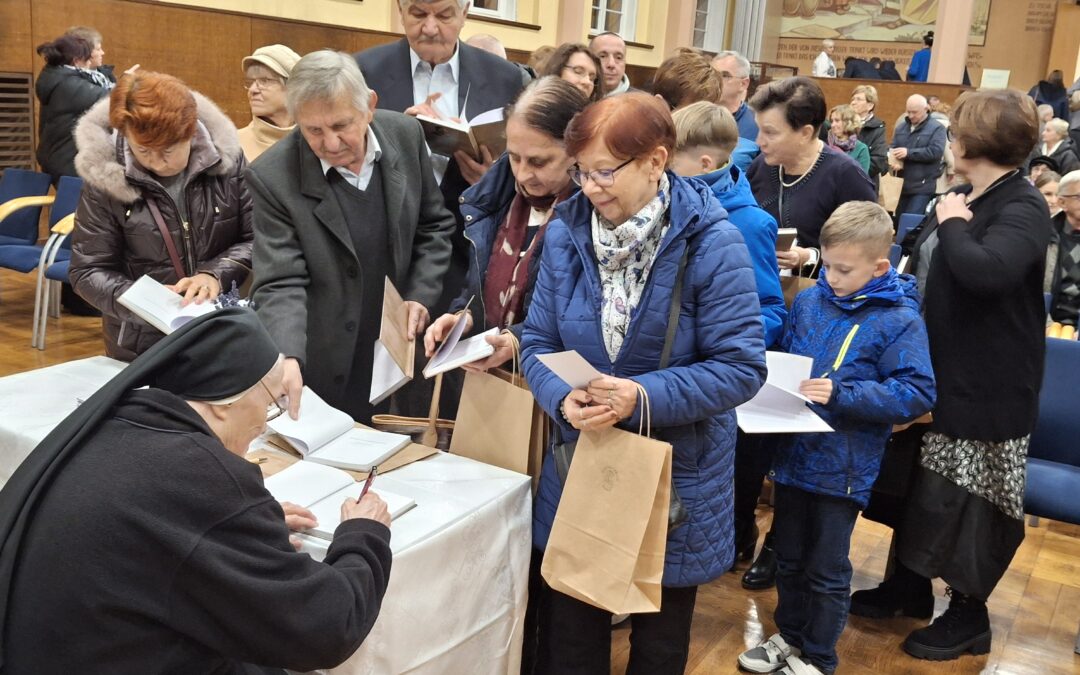
“Do mercy” this request and encouragement of Fr. Jan Schneider, the founder of our congregation, here in Branice, under the guidance of Bishop Nathan gave the sisters serving in Branice a new and fresh quality of mercy rendered. On Saturday, November 9, in the City of Mercy, during the Eucharist, we gave thanks for the person and work of Bishop Nathan. A prayer for the beatification of God’s servant Bishop Nathan, a concert by the FLOW Band, as well as the promotion of a book written by Sister Alodia Lelek dedicated to Bishop Nathan completed the solemn thanksgiving of the day.
In 1974, Sister Alodia Lelek SMI undertook to write her master’s thesis on Bishop Nathan at the Theological Faculty of the Catholic University of Lublin. This year, on the occasion of Bp. Nathan’s anniversary, Sister Alodia’s thesis was published in book form through the efforts of the Caritas Christi Association. The publication is titled: THE FATHER OF THE POOR. The life and work of Father Bishop Joseph Martin Nathan (in the years 1867-1947).
Sister Alodia assiduously, for three years, collected the necessary materials on the person of Bishop Nathan, she also obtained information from the sisters who knew the Bishop personally. The sisters also assisted Sr. Alodia in translating the acquired writings and documents in Polish and Czechoslovak archives.
In the introduction to her work, the author admits:
It is hard to believe that already fifty years have passed since I wrote my master’s thesis on Bishop Joseph Martin Nathan, the book edition of which has just reached readers interested in the life and work of this great man. The topic of my thesis actually arose partly by accident. I was studying with a sister of the Wroclaw Province and to her I gave priority to choosing the topic. She chose the topic of the history of our congregation, and I chose one about Bishop Nathan. Only after time did I realize that it was a blessed coincidence Discovering more and more documents about Fr. Bishop Nathan, I was able to learn more and more about the uniqueness of his person. Today, I am happy that this work can also bring the figure of the Bishop closer to others who will be reached. In all the work of the City of Mercy, it is worth emphasizing the great care for every detail of the medical care, the farmyard and the church. Inviting the Sisterhood to help was an important aspect of the Bishop’s care for the sick. He counted on the generosity and spirit that the Sisters would bring to the place, and he was not disappointed. Everything was to bring relief to the suffering and anguish of the mentally ill. Today it gives hope that the current director Krzysztof Nazimek has understood the thought of Fr. Bishop Nathan and continues his mission It only remains for me to wish everyone an enjoyable and spiritually enriching reading experience.
Endowed with many charisms, Bishop Martin Joseph Nathan inspires great respect and the phenomenon of the City of Mercy he founded continues to delight, arouse admiration and generate gratitude. Undoubtedly, Sr. Alodia’s work presents Bishop Joseph Martin Nathan as a man, a priest, a bishop with a fascinating imagination of mercy.
s. Małgorzata Cur SMI

Nov 13, 2024 | DAILY BREAD
Thursday of week 32 in Ordinary Time
Gospel – Luke 17:20-25
“For, you must know, the kingdom of God is among you”. This is the biggest truth of all times. It’s about the incarnation of God. God is with us. He became man. All the false images are gone. All the human fantasies about God are gone. God is real and He is amongst us. Jesus shifts the understanding of God’s kingdom from a distant, future event to a present reality. Through Jesus, God is not a remote or abstract being but one who walks with us, shares in our joys and sufferings, and reveals the true nature of divine love. The false images and fantasies that people may have created about God—depicting Him as detached or inaccessible—are dispelled by the reality of Jesus’ life and mission. This truth challenges us to seek and encounter God in the here and now. It calls us to live with an awareness that His kingdom is unfolding within us and around us, in our daily interactions, in acts of love and mercy, and in the ordinary moments of life. By embracing this reality, we participate more fully in the presence of God in us and around us, embracing the hope and transformative power of the kingdom of God. Let’s reflect: In what ways am I recognizing and welcoming the presence of God’s kingdom in my daily life?
Don Giorgio

Nov 12, 2024 | DAILY BREAD
Mittwoch der 32. Woche der gewöhnlichen Zeit
Evangelium Lukas 17,11-19
Jesus sagt: „Wurden nicht alle zehn rein gemacht? Wo sind die anderen neun? Es scheint, dass niemand zurückgekommen ist, um Gott zu loben, außer diesem Fremden“. This passage from Luke 17:11-19 offers a profound lesson on gratitude and faith. The story highlights the healing of ten lepers, but only one—a Samaritan—returns to give thanks to Jesus. His action is more than just politeness; it reflects a deeper recognition of God’s grace at work. Gratitude, as Jesus points out, is more than a human response; it is a divine act of faith. By returning to express his thanks, the Samaritan demonstrates humility and acknowledgment of God’s power. Jesus’ words, “Your faith has saved you,” suggest that his gratitude is intertwined with his faith. It’s not merely about physical healing but a spiritual transformation, signifying salvation. In our human experience, gratitude often arises when things go well, when blessings are obvious, or when relief follows hardship. However, a divine perspective invites us to cultivate gratitude even in challenging or uncertain times. This shift requires faith—a trust that God’s presence and purpose remain constant, even when life feels difficult or unclear. Gratitude as a divine response transcends mere acknowledgment of good fortune; it becomes an act of worship, a recognition of God’s hand in every aspect of life. Let’s reflect: How often do I pause to acknowledge and express gratitude for the blessings in my life, especially in times of struggle or uncertainty?
Don Giorgio

Nov 11, 2024 | DAILY BREAD
Saint Josaphat, Bishop, Martyr
Tuesday of week 32 in Ordinary Time
Gospel Luke 17:7-10
“We are merely servants: we have done no more than our duty.” These words invite us into a profound reflection on the nature of service and vocation. Here vocation is a mission. This teaching challenges us to adopt a mindset of humility and selflessness, particularly when it comes to our vocation and mission. Vocation is more than a career or a set of tasks; it is a mission entrusted to us by God. Whether our calling is in ministry, teaching, healthcare, or any other field, it is a sacred responsibility. When we see our vocation as mission, we recognize that it’s not about personal ambition or external validation but about participating in God’s plan and serving others. And this we must do in humility. The servant in the parable does not seek special treatment or acknowledgment but continues to serve faithfully. And our reward is not in human applause but in knowing we are fulfilling God’s will. While we are called to follow Jesus Christ, He equips, sustains, and empowers us. Every task, no matter how small or mundane, takes on new meaning when done as part of your following of Christ. And always the joy comes from the intrinsic satisfaction of doing God’s will. Let’s reflect: Do I understand that my mission, unseen by many, is seen and valued by Jesus?
Don Giorgio

Nov 10, 2024 | DAILY BREAD
Saint Martin of Tours, Bishop
Monday of week 32 in Ordinary Time
Gospel – Luke 17:1-6
“Jesus said to his disciples: ‘Obstacles are sure to come, but alas for the one who provides them! It would be better for him to be thrown into the Sea with a millstone put round his neck than that he should lead astray a single one of these little ones”. As followers of Christ, we are meant to be conduits through which God’s love, mercy, and grace flow into the lives of others. When we act in ways that hinder this—whether through judgment, pride, or unforgiveness—we disrupt not only their connection to God but also our own. To obstruct someone else’s experience of grace is to place ourselves outside the rhythm of God’s will, distancing ourselves from His presence and purpose. Being a channel of grace means embracing humility and compassion. It calls for an openness that allows God’s love to pass through us freely, touching others without distortion or obstruction. When we impose our own biases, withhold forgiveness, or act out of self-interest, we effectively block this flow. Such behavior not only harms those around us but also isolates us from the path God has laid for us. This disconnection is spiritually perilous. Let’s reflect: Am I a channel of grace or an obstacle of grace to others?
Don Giorgio
