Nov 28, 2021 | NEWS
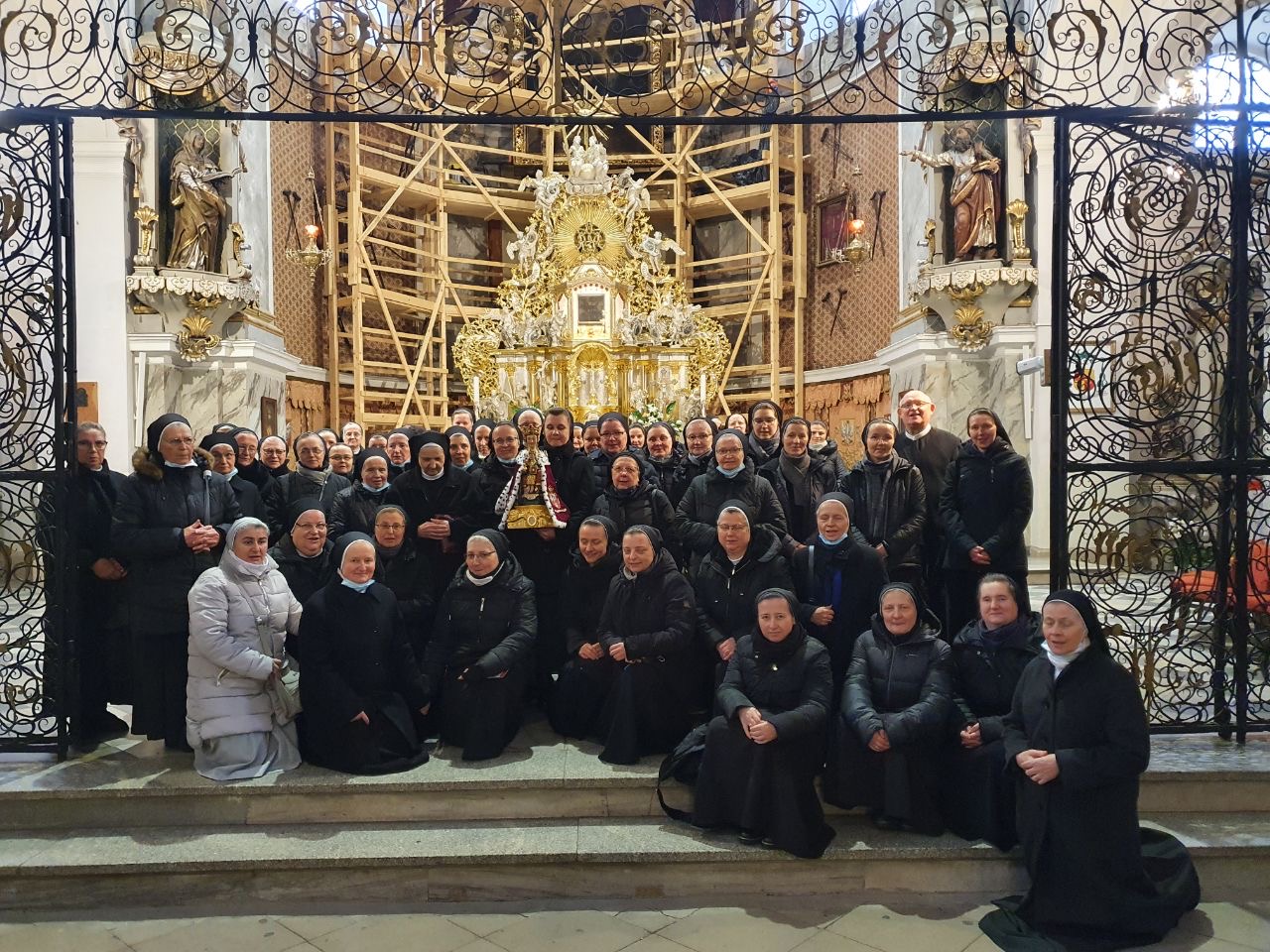
On Sunday, November 21, another pilgrimage of the Sisters of Mary Immaculate took place to Our Lady, the Keeper of Faith in Bardo.
The tradition of this pilgrimage goes back to the beginnings of the Congregation. At a time when a young, small community began to form, a government decree to liquidate orders (Kulturkampf) was issued. The sisters realized that this was a hopeless situation, so they made the effort to make a pilgrimage to Our Lady to ask for a miracle of salvation. After several days of intense prayer, they returned to the monastery and at the same time received a state decision that they could stay in the monastery and not be secularized. After this event, the sisters made a promise that each year they would go on pilgrimage to the throne of Mary to give thanks for saving the Congregation. It is now an opportunity for us to thank for all the favors the Congregation has received in its history and for the favors that each sister receives.
Despite the still developing pandemic, the sisters came in large numbers to the Sanctuary of Mary, Keeper of the Faith in Bardo. During the solemn Mass and in praying the rosary they thanked for the protection of Mary and asked for strong faith for the future. Sanitary restrictions did not allow kissing the statue of the Mother of God, but the Priest presented it in front of the altar so that we could worship before Mary through prayer and gestures of respect. After a long time, we could be together again and Mary was among us and with us.
SMI
Nov 26, 2021 | NEWS
I would like to share my travel experience during epidemic season!
After this huge crisis of Covid-19 each and everything has been affected in the world; socially, economically and in religion has totally changed in terms of worshiping God. So in the middle of this hard time, I got a chance to travel to Europe for Congregation matters and also holiday. Un expectedly I travelled in three countries simultaneously due to the problem of my Visa for Italy which delayed due to the new travelling system.
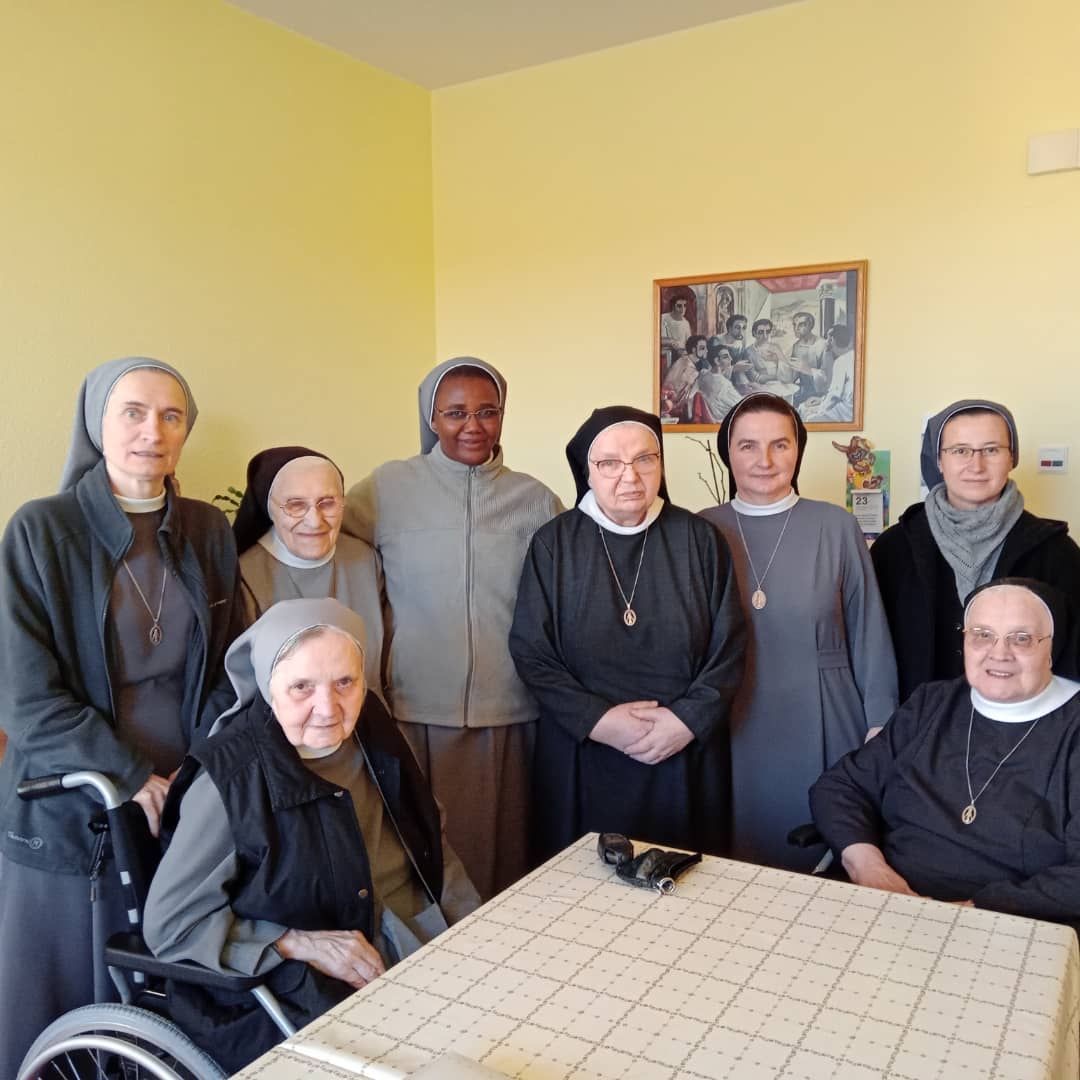
I started my journey from Tanzania on 15th October 2021 and first, I arrived in Poland, then Berlin and lastly in Rome/Italy.
I can admit that, language, unity and love are the values which contributed to good communication with the Sisters I met in Europe, it was very fun and interesting, I did not know the Polish even German language but when I was there; I didn’t feel the countries difference, it was like; I was in Tanzania. I communicated with the Sisters through gestures especially when there was no one near to translate and we understood well each other and both were so happy.
The Sisters were so interested to ask me many different questions concerning our Region and the life in general in Tanzania. I tried to answer and explaining all things they were interested to know about our Congregation life in our Region and they were so happy. One thing was so amazing for me is that; For example I used to communicate with Sister Luka in German by using Google translate in my phone to pass my gratitude message to the Sisters, then after sending the message was read and the feedback was good. In general, I enjoyed my time in Europe by learning many things from my fellow sisters in Poland, German and Rome.
For me I can say that; every day is a day of learning and growing. Love and unity goes together and have a lot of power because through them we are always connected together regardless of our traditions, language and color.
Sr. M. Agnes Mwanajimba
Region – Tanzania
Nov 25, 2021 | SPIRITUALITY
Memories of German history
Do you remember? The occupations of the German embassies in Prague and Warsaw in 1989, the opening of the border between Austria and Hungary, the Monday demonstrations in Leipzig and other places, the first opening of the Wall on November 9, 1989 and finally the Day of German Unity on October 3, 1990. Back then, they were eventful and eventful weeks that we all experienced with excitement. And many feelings accompanied us: worry and great fear, but also hope and joy. And when the unification treaty was finally signed, quite a few also folded their hands and thanked God. German unity was not just the work of people, it was also felt as a gift, a gift from above, from God.
There are two extreme positions that could be associated with this topic of “gift unity”, and which I would like to briefly suggest here.
Put your hands in your lap
On the one hand, one might think: if unity is a gift, then I cannot and do not need to do anything. Then I can put my hands in my lap and wait for unity to come from God. I would like to warn against this assumption. I am sure that German unity would never have come about without the efforts of many on both sides: politicians, scientists, representatives of the churches, artists and many ordinary citizens.
Furthermore, I am not only thinking of German unity. Christians are also divided into different denominations. And I am grateful and happy that many Christians do not put their hands in their laps and wait for God to make a difference, but rather that they cooperate and approach one another, even if they know that unity is ultimately a gift.
Ordered or forced unity
Unity cannot be made, let alone order. This is shown by the recent history of several European countries. The Soviet Union quickly fell apart during the time of glasnost and peristroika. In the former Yugoslavia, the 7 republics immediately declared their independence after Tito’s death. And even in countries like Great Britain or Spain, unity is sometimes at stake. A prescribed or even enforced unit seldom lasts.
So reality lies in the middle. Unity is a gift, but I can do a lot to ensure that this gift can become and remain a reality.
Appreciation as a breeding ground for unity
Unity needs another breeding ground for it to grow. This breeding ground is mutual respect. There are wonderful examples of this as well. Pope Paul VI met the Patriarch Athenagoras in 1964 and thus took an important step towards bringing the Orthodox and Catholic Churches closer together. And with his visit to Warsaw in 1970, Willy Brand certainly also set a milestone on the way to German unity. Of course, you cannot do the unity with such activities. With certainty, however, one can create the conditions on which the unity can then grow. Receiving gifts and doing something for them are not mutually exclusive.
Resignation and accommodating
The mutual appreciation that I show for the other is certainly a great gift that contributes a lot to unity. But there are other gifts that don’t have much to do with giving at first.
Even as a child I learned that I had to forego some things in the family and make compromises. I experienced that with my parents, then with my siblings and also with me. In the beginning, this waiver was certainly not voluntary, but rather forced. But later I was able to experience that this kindness and renunciation also contributed to the fact that we grew together as a family and that we are still in good contact with one another today.
Compromise and renunciation as our parishes grow together are of very topical importance. Here, a waiver is often necessary, e.g. when choosing a church as a parish church or when redistributing financial resources. If there is only anxiety that I don’t miss out, unity can never grow. Only when the common whole becomes more important to me than my own interests can a parish arise.
Gratitude: maintaining unity
You put a bouquet of flowers in the water to keep the flowers fresh for a long time. I go out carefully with a given bike so that I can ride it for a long time. Gifts want to be cared for. This is certainly the most beautiful way of appreciating gifts and thanking the giver of the gifts. That applies to the German unity that was given to us 30 years ago. This also applies to the unity of Christians, which we continue to strive for. And that certainly also applies to the unity in a convent, a religious community, a presbytery, a congregation.
Prelate Dr. Stefan Dybowski
7th, October 2021 monthly lecture St. Augustinus Monastery, Berlin-Lankwitz

Nov 25, 2021 | POSITIVE IMPULSES
Somethings stay and somethings pass away. The more we chose what stays the more we are stable and the more we chose that passes away the more we are instable and in confusion. But the choice is ours. We must decide and chose what is valuable in life. We should not be deceived by the appearances. Understand the value of things and situations in its depth and not just the convenience which that brings. Go beyond the convenience to the real value of things to make the right choice of things which will stay forever.
Don Giorgio
Nov 25, 2021 | NEWS
The Son of Man came to seek and save what was lost.
These words of the Good News were taken over by the clerk of the Wrocław police, Mr. Uhden, a zealous Catholic. When Bishop Henry Förster was the parish priest in Kamienna Góra, a police employee served as the mayor. He cooperated fruitfully with the parish priest. The friendly relations with Kamienna Góra remained when they were both promoted to Wrocław.
On January 19, 1854 the former mayor reported to the bishop about the tragic moral situation among the servants. He proposed that one of the Catholic clergies should organize a shelter for servants of the Catholic faith so that they would not have to go to suspicious places for the night. He also proposed to organize an association of Catholic women who, knowing well the needs of the girls, would support the minister of servants.
Bishop Förster passed this report to the dean of Wrocław, Fr. Thiel, the parish priest of the Corpus Christi parish in Wrocław. The dean, after consulting Wrocław parish priests, replied to the Ordinary that he saw the benefits of establishing an association for servants
Bishop Förster instructed the Dean to convene a dean’s conference to discuss the creation of a new pastoral ministry and to appoint a suitable priest from among the priests to organize a shelter for servants and to care for them. All priests unanimously chose Fr. John Schneider, to organize a shelter for the Moral Elevation of Servant Girls. Father John Schneider replied “yes” to the priests’ proposal. At that time, he was only 30 years old, including 5 years as a priest.
Fr. John Schneider acquainted his parishioners with the problem of serving girls and asked for help from his parishioners who knew the working conditions of girls and young women in Wrocław from their autopsy. Seven brave members of the parish of St. Matthias established the board of the new Marian Foundation with Father John Schneider as a leader. To begin with, the foundation rented two rooms for girls in a tenement house near the church of St. Cross, the same one where our Founder lived during his university studies. Each of the members of the Board was commissioned by Father Schneider to look after one of the city’s districts. Women paid special attention to railway stations, because this was where girls looking for work in a big city came and were exposed to pimping. Girls from Upper Silesia and the Opole region came to the Upper Silesian Railway Station (today Wrocław Główny), to the Świebodzki Railway Station from the Sudetes, and to the Marchijski Railway Station from the direction of Zgorzelec.
In mid-October 1854. The Servant of God gave Bishop Förster an approval of the statutes drawn up by the Foundation’s Management Board, which the Wrocław bishop approved without hesitation. Then, Father John handed over the statutes to the police office for an opinion. The document was approved by the police at St. Elizabeth of Hungary, great apostle of works of mercy.
On November 14, 1854 The founder published an appeal to the clergy and lay people in the Silesian Gazette Kościelna under the title ‘A Call for Help. The article showed the main goal of the Foundation: to prepare for life and educate poor girls who have faced the abyss of moral corruption. It was a tragedy that many village girls, due to the lack of proper care, lack of work, accommodation, ignorance of city life, became victims of prostitution. Difficult living conditions were the cause of their crimes, which ended in imprisonment. In this appeal, the author revealed a plan to buy a house so that servants who seek employment can live in it until they find a suitable job. This house would be able to save them from demoralization. He had a chance to buy such a house for 10,000 thalers. Many people with a good and sensitive heart, regardless of religion, responded positively to his appeal. Father John Schneider suggested that Our Lady of the Immaculate Conception and St. Rose of Lima, a tertiary of the Dominican Order, were to be the patrons, on December 8 – was the Solemnity feast of the Immaculate Conception of the Blessed Virgin Mary
On December 8, 1854, the members of the Association, families supporting the work and the girls serving themselves at the Church of the Holy Name of Jesus received the sacrament of penance and general Holy Communion, and then consecrated themselves to Our Lady of the Immaculate Conception as their patron, entrusting themselves and the work of their future to the Mother of God.
What is the place of Our Lady in my life?
Sr.M. Elżbieta Cińcio
