
Oct 24, 2021 | POSITIVE IMPULSES
A mentality to share the good we have, should be a constant mission. In reality, the sharing dimension is an intrinsic part of every good that reaches us. If we don’t share, that good gets stagnant in us and it will lose it “divine” nature. It transforms into selfishness. So, in order to get the maximum out of each good that comes to us, we must be just channels. Channels of goodness and not to block it in us. Let it flow to all around us. Then it’s mission accomplished.
Don Giorgio
Oct 23, 2021 | HISTORY, NEWS
In today’s Gospel, the Lord Jesus will command his disciples; Let your loins be girded, and let your torches be lit. And you, be like those who are waiting for your master when he returns from the wedding feast, to open to him immediately when he comes and shakes.
Servant of God Fr. John Schneider wanted to prepare as best as possible to meet Christ when he received the sacrament of priesthood. After passing the matriculation examination at the Carolinum in Nysa, which took place on September 20, 1845, he went to study in Wrocław with 13 classmates. Only one of the high school graduates chose medical studies, the rest enrolled in theology.
In the time of our Founder, if a candidate for the priesthood wanted to enter a theological seminary, he had to first, as a layperson, graduate from theological studies. The University of Wrocław had a faculty of Catholic theology with 199 students, of course only men, and a faculty of Evangelical theology with 72 students in the academic year 1845/46. The students lived in private stations. John Schneider rented a room in Ostrów Tumski next to the church of St. Krzyża, in the tenement house at No. 9. He suffered a lot from cold. He lived with a friend in an unburned room. To warm the stove a bit, they put a candle stump in it. When the owner of the lodgings noticed this, she started to burn them in the stove at her own expense.
For three years, from 1845 to 1848, he studied theology and served as a volunteer in the 11th Grenadier Regiment in Wrocław. He used the experience gained in the army during the revolution that broke out on March 6, 1848. in Wrocław on the wave of the spring of peoples and solidarity with social movements in France and Austria. In Wrocław, there were bloody clashes with the revolutionary-minded inhabitants of the city. The speeches were left-wing and anti-clerical. During the riots, revolutionaries attacked the apartments of members of the cathedral chapter in Ostrów Tumski. It was then that John Schneider organized a team of fellow students, leading it himself, and defended the endangered canons of Wrocław against the attackers. His brave attitude won him the kindness of the members of the Wrocław chapter and his colleagues awarded him the title of “generalissimo”.
After three years of studies at the University of Wrocław, the Servant of God entered the seminary in October 1848, which at that time was called the Alumnate and was located in the place where the Archdiocese Library building stands today. Candidates for the priesthood were trained in pastoral theology, liturgy and asceticism for 9 months.
The superiors of the Students gave Father John the following opinion: “Big, healthy. sufficient talent, satisfactory zeal, satisfactory behavior, diligent character, compatible – with good will, sermons also satisfactory, catechism satisfactory ”.
During his stay in the Aluminae, John Schneider received a clerical attire, tonsure and four lower priestly orders: ostiarate, language, exorcist and acolyte, and three higher ones: sub deaconate, diaconate and presbyterate. He was ordained to the deacon by auxiliary Bishop Daniel Latusska on June 21, 1849 in the Church of St. Cross. Along with him, 38 alumni from the Archdiocese of Wrocław and 4 from the Archdiocese of Olomouc were ordained.
He was ordained a priest by the bishop of the Archdiocese of Wrocław, Prince Bishop Melchior von Diepenbrock on July 1, 1849 in the Church of St. Cross. The day of priestly ordination of Fr. John Schneider considered it the most important in his life. It was a day for him on which, after several years of preparation, he met his Master in the sacrament of priesthood. He was prepared for this solemn moment by difficult events, marked by material poverty, requiring great denial and faithfulness to his own life vocation.
How do I perceive the difficult events that I face in my own life? Do they prepare me to meet Christ?
Sr.M. Elżbieta Cińcio

Oct 22, 2021 | POSITIVE IMPULSES
One of the ways, we complicate our life and especially the life of those around us is to present our problem as the problem of the whole world. The same with experiences. This complicates the whole situation around us. When my problem which I should deal is presented as the general problem, I confuse everyone around me. Only because I don’t know how to deal with it. Presenting my issue as the issue of everyone is not the solution for my issue. So, avoid these situations by facing our problems by ourselves with courage to make easy the life of those around us.
Don Giorgio
Oct 20, 2021 | SPIRITUALITY
In the course of the many thoughts that we have already given ourselves on the subject of “unity”, one thing has become very clear. Unity is not something that is there. Unity are relationships that arise, that can grow and be deepened, and which must be dealt with carefully so that they are not lost (see also the letter from Sr. Sybilla). So today I want to reflect with you on how unity can emerge and be deepened.
Unity starts with me
There is a realization that we make in the course of our lives – one sooner, the other later, and which is often very painful: I cannot bake my fellow human beings, i.e. bend them into the way I would like them to be. That would only be done by force and often takes bitter revenge. World history knows numerous examples of this, and many people can also tell of these experiences: parents, teachers, pastors. This is also an important insight for any community. I cannot achieve unity by using rules and regulations to urge others to do something together.
I cannot change the others. Change can only start with myself. This is how the first step towards unity begins with myself.
Unity grows gradually
One of the most famous parables of Jesus is the parable of the seeds. Nature takes a lot of time to grow and bear fruit. What applies to nature also applies to human life. Here are two current examples:
– German unity
We can learn a lot from German history on the subject of unity. One of these experiences is that unity is slow to develop. After the period of demarcation in the “cold war”, a policy of rapprochement between the two German states followed in Germany. And it was a long road that led to reunification.
– ecumenism
There are similar experiences in the field of ecumenism. Here, too, there are many efforts to bring the two major Christian denominations closer together.
Above all, it becomes clear that this approach is from below. People get to know each other, discover the lovable sides and strengths of the other and can thus overcome separations and divisions.
Unity costs something
Do you know the saying: “What doesn’t cost anything is also worth nothing.” I don’t think very much of this saying. It is similar to the misconception that medicine has to taste bitter if it is to help. But with the unity, I would say that it has its price. What does the unity cost?
Memories of school days: some children learned to read and arithmetic faster, some children took longer to do so. Our teacher had often shown a lot of patience so that the weaker students could also follow and the class would not be split into two groups.
Experiences on a hike together: the fast in the group had to wait again and again so that we as a group could reach the goal together.
Patience, consideration, the necessary humility … these are important steps on the way to unity.
Give a piece of you
I would like to tell you the most beautiful, but certainly also the most expensive price for the unity with the story of the salt man.
A salt man finally came to the sea on his wandering through the endless deserts. He had never seen the sea and stood in front of it, completely fascinated. He was impressed by the power of its waves and felt the freshness that emanated from it.
“Good day!” Said the salt man. – “Hello,” answered the sea. Who are you? ”Asked the salt man. – “I am the sea,” answered this one. “What does that mean?” Asked the salt man. “I don’t know you yet.” – “If you want to get to know me, you have to come closer.”
So the Salt man took a step closer, and then another step and another, until one foot was in the water. And indeed: suddenly he felt the wonderful freshness of the sea and its power. But when he came out of the water again and looked at his foot, the foot was gone.
“What did you do with my foot?” Asked the little salt man excitedly? “But the sea stayed calm:“ If you want to get to know me, you have to give a piece of yourself. ”-“ If you want to get to know me “You have to give a piece of yourself,” repeated the salt man, in order to memorize it well. And again he put one foot into the sea, and then the other, and on and on he went in and had the exhilarating feeling of getting to know the sea better and better.
(from Chinese)
If you want to get to know me, you have to give something of yourself … that applies to the emergence and growth of relationships, that also applies to the unity of a community.
Prelate Dr. Stefan Dybowski
13th, September 2021 monthly lecture St. Augustinus Monastery, Berlin-Lankwitz
Oct 19, 2021 | HISTORY, NEWS
At the Holy Mass that will be celebrated later, the priest, while praying the collective, will pray to God on behalf of all of us: May your grace always precede us and always accompany us, prompting our zeal to do good deeds.
The first place in everyone’s life where we have the opportunity to learn to be zealous and do good deeds is the family home. Such was also the house of the Servant of God Father John Schneider.
Our Founder was born on January 11, 1824 in Mieszkowice in the Prudnik region. Two days later he was baptized in the local branch church of St. George. He was given the names John Jerzy, which were borne by his father and his paternal grandfather. Father and godmother came from Mieszkowice, in addition, he also had another godmother from his mother Katarina’s home village, i.e. from Łąka Prudnicka.
In the Schneider house, two more sisters were born after John, so a family of five was the environment that shaped the attitude of our hero, sensitive to human poverty and hurrying to save people standing on the chasm of moral evil.
Today, on the outskirts of Mieszkowice, we will no longer see Father John’s family home. At this point, my Congregation placed a white statue of Our Lady Immaculate on a pedestal.
Catholics in Mieszkowice constituted a religious minority in relation to the local Protestants. The Catholic primary school was located in the neighboring town of Rudziczka, which also had a parish church. So the Servant of God, from the age of six, traveled two and a half kilometers each way to school every day, until he finished seven classes. He regularly served at the Holy Mass. in the church in Mieszkowice. He had a dream that was humanly impossible to realize, he wanted to serve God as a priest. It was associated with obtaining secondary and higher education. And his parents couldn’t afford to send their son to school.
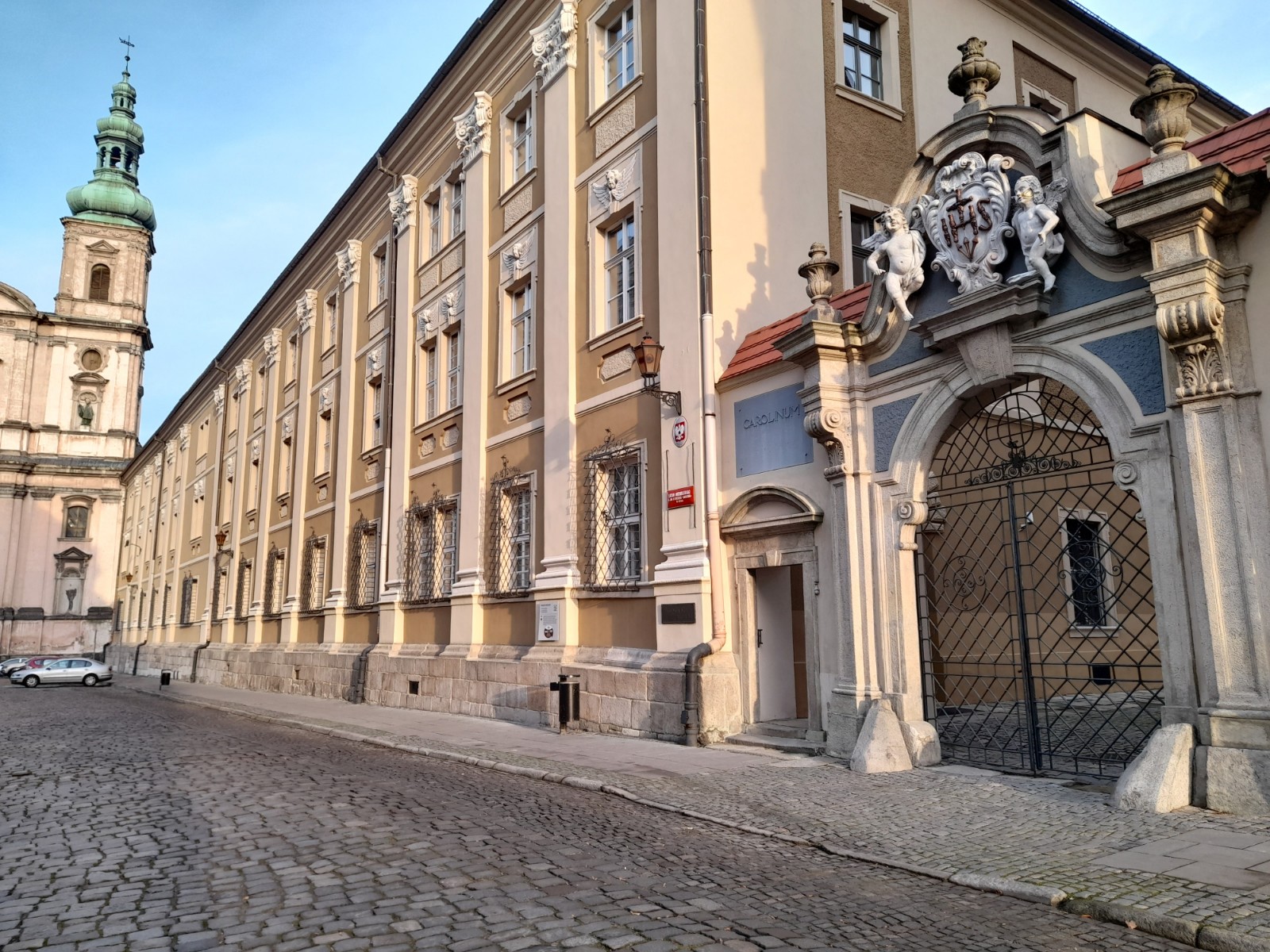
Divine Providence put on his way the noble priest serving in Rudziczka, Father Antoni Hoffmann, who was concerned with helping children to get education in accordance with their abilities and fulfill their bold dreams. During his parish priesthood, he helped three boys to obtain ordination. One of them was John Schneider. The parish priest persuaded his parents to send their son to Nysa, to Carolinum and offered material help. It was a high school with traditions, graduates of which were, among others, the king of Poland, Michał Korybut Wiśniowiecki, son of King John III – Jakub. Our Founder spent eight years of education in Nysa on diligent learning, experiencing material shortages and serving as an altar boy in the school church of the Assumption of the Blessed Virgin Mary. John did not have a watch and he would wake up by feeling at night to punctually at 5.00, stand at the foot of the altar and serve the Father Director of the Carolinum for the Holy Mass. More than once he stood at night for several hours with the church door closed, and the city night guard sent him back with the words: go back home , because it is only one o’clock in the morning. For the service of an altar boy he received 1 talara annually, which at that time was a payment for a farm worker for one working week.
He took the secondary school-leaving examination in 1845. It was written on the matriculation certificate that John Schneider devoted himself to all subjects with great diligence, and in what he did, you could see punctuality, a love of order and diligence. He received excellent grades in religion and mathematics. Unfortunately, his mother could not enjoy her son’s successes, because she had passed away to the Father’s House a year earlier.
John Schneider set off for Wrocław with his high school diploma in hand.
In the moment of reflection, let us ask ourselves the following questions:
What is left of my teenage dreams? Who supported me in realizing my noble desires?
Sr.M. Elżbieta Cińcio
