Feb 10, 2021 | POSITIVE IMPULSES
Unexpressed thoughts make a good percentage of our thoughts. Mostly passed as personal and under our control. But the truth is that the unexpressed thoughts are not fully under our control. They subside into us but subside actively in us. So, it is important that the unexpressed thoughts are also positive. Do not get comfortable by the fact that no one else is knowing those thoughts. The negative unexpressed thoughts opaque our expressed positive thoughts. Therefore, train the mind to generate always positive thoughts whether expressed or unexpressed.
Don Giorgio
Feb 7, 2021 | FORUM
This day for life is a national day of remembrance in Italy and is of course especially celebrated in the church.
For some time now, our convent has been going to the nearby parish church of St. Francis for Holy Mass on Sundays. It is run by a convention of Piarist Priests. Also on this February 7th we were there for Holy Mass and the priest of the parish, Padre Stefano, naturally also addressed this topic in his sermon. It touched us very much and I would like to share a few thoughts about it with you.
Fr. Stefano began his sermon by reminding us that Christian life also has a prophetic dimension. This dimension does not mean to predict things of the future, but to say the word of God into our present time and above all to live it. He made this clear with two examples from his time as a priest in the Ivory Coast, a country in West Africa. He saw the first example around 2003. He received a call from a catechist. French is spoken in the Ivory Coast, and the catechist spoke French too, if not a good one. Father Stefano could hardly understand him. But the catechist called several times and so the priest realized that it was urgent and therefore went on his way to see what it was about. He came to a small village and the catechist received him with a small, newborn child. This child had given birth to a Muslim woman, but it was not her husband’s child. According to Muslim law, such a child could not stay in the family and it was a lot that she was allowed to give birth. It had been brought to the catechist in several detours. But what should happen to the child now? Fr. Stefano first brought the child to a medical examination to make sure that it was healthy. Of course, word of this had got around and a young woman answered who was ready to take care of the child. Fr. Stefano and the catechist then spoke to the family to see if they agreed. They were it. But not only did they agree to this, but in the near future some family members contacted Fr. Stefano with the wish to become Christians. She had been impressed by the commitment of the priest and the catechist. Not only was a teaching proclaimed here, such as the preciousness of human life, but it was lived convincingly in everyday life.
He saw the second example years later, in 2011, when civil war broke out in the country. The mission station of the Fathers was exactly between the fronts, i.e. between the government troops and the rebels. There was shooting and the people in the area were afraid and sought protection at the mission station, among other things. They came in droves and soon there was no more space. In this tense situation, Fr. Stefano called the bishop and asked him whether it was possible that people could sleep in the church, otherwise they would have no more space. There were over a thousand people. So the church became a place to sleep for those seeking protection. Among these people was a young, heavily pregnant woman and the time of childbirth came for her. What now? Fr. Stefano acted quickly and took her to the nearest hospital. But this was closed in these troubled times. So he drove back to the mission station. There they tried to prepare a small, protected and separated room for this woman. She gave birth to a healthy girl without complications. This woman was also a Muslim. But after the birth she also asked to be allowed to become a Christian, because the selfless commitment of the Father had convinced her that the God of Christians is really a philanthropic God, to whom the life of every person is precious, regardless of his religion, his Gender or race and nation.
Fr. Stefano ended his sermon with the call to all of us that we, as Christians, must take this prophetic dimension of our lives seriously and how important it is not to preach catechesis in words but to live it convincingly and authentically in everyday life.
Sr. M. Petra
Feb 7, 2021 | FORUM
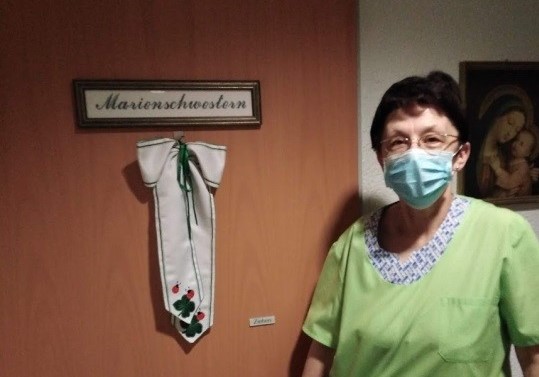
I am happy to meet you here in our senior citizen center in Cochem on the Klosterberg, our employees. Yes, and today I happened to meet “our” Agatha while cleaning and just said to her:
“Nice that you are here and keep order:”
Her answer: Sister Agnes taught us how to make order 50 years ago.
I came to the Klosterberg in 1972 for a housekeeping year and then stayed with Sister Agnes for 25 years.
It was not always easy to get along with her and to please her … but for my personal life I have – learned a lot from her and I’m proud of that now.
Next year I will retire – then I was with the Sisters of Mary for a total of 50 years and I can only be amazed where the time has gone.
It was and is a precious time. I like to look back on the past few years – even now I like coming into the house and am always happy when I do.
“My Sisters of Mary” meet – they always have a good word for us employees and we know that they pray for us … that feels so good !!!
Yes, what would have become of me – if the sisters hadn’t accompanied me on my journey through life.
I am very grateful to everyone and I will continue to be loyal to the sisters. The sisters have now grown old and maybe I can at least give them back some of the good things I got from them ”.
Ms. Agatha works as an employee in all housekeeping areas in Klosterberg. She ensures order in the whole house, even in the places that are otherwise easily overlooked.
We thank her and wish her continued God’s blessings.
Sister M. Felicitas
Feb 6, 2021 | NEWS
Parish of Saint Matthew and Matthias in Brzezie on the Oder
On Sunday, February 7, 2021 at 10.30 in the parish church of St. Mathew and Mattias,We would like to thank the Holy Apostles Matthew and Matthias in Brzezie, for the gift of life, vocation and service of the servant of God, Sr. M. Dulcissima Hoffmann SMI. During the Eucharist ceremony, the homily will be given by Fr. Przemysław Krakowczyk, PhD, SAC.
TV Misericordia
The Holy Mass will be broadcast courtesy of Internet Television: TV Misericordia
https://www.youtube.com/channel/Telewizja Misericordia
I pasted this link in the description above
https://www.youtube.com/channel/UCJdDpDfW-Lvfq0qs44LYDUA
St. Józef Robotnik in Świętochłowice Consent
Thanksgiving Mass for the gift of Sr.M. Dulcissima Hoffmann with a request for beatification, will be held on Sunday, February 7, 2021 at 07.30 in the home parish of the Bride of the Cross in Świętochłowice Zgodzie.
Transmission from the Church of St. Józef available on the YouTube channel at:
https://www.youtube.com/channel/ZgodaParafia
I pasted this link in the description:
https://www.youtube.com/channel/UCGvPg4_uaYRqXpFDRvoPJUg
Spiritual participation
In view of the epidemic situation in the country, we encourage the Friends of the Bride of the Cross to spiritually participate in thanksgiving and pray together.
https://youtu.be/thfmnRL7tI8
S.M. Małgorzata Cur SMI
Feb 5, 2021 | HISTORY
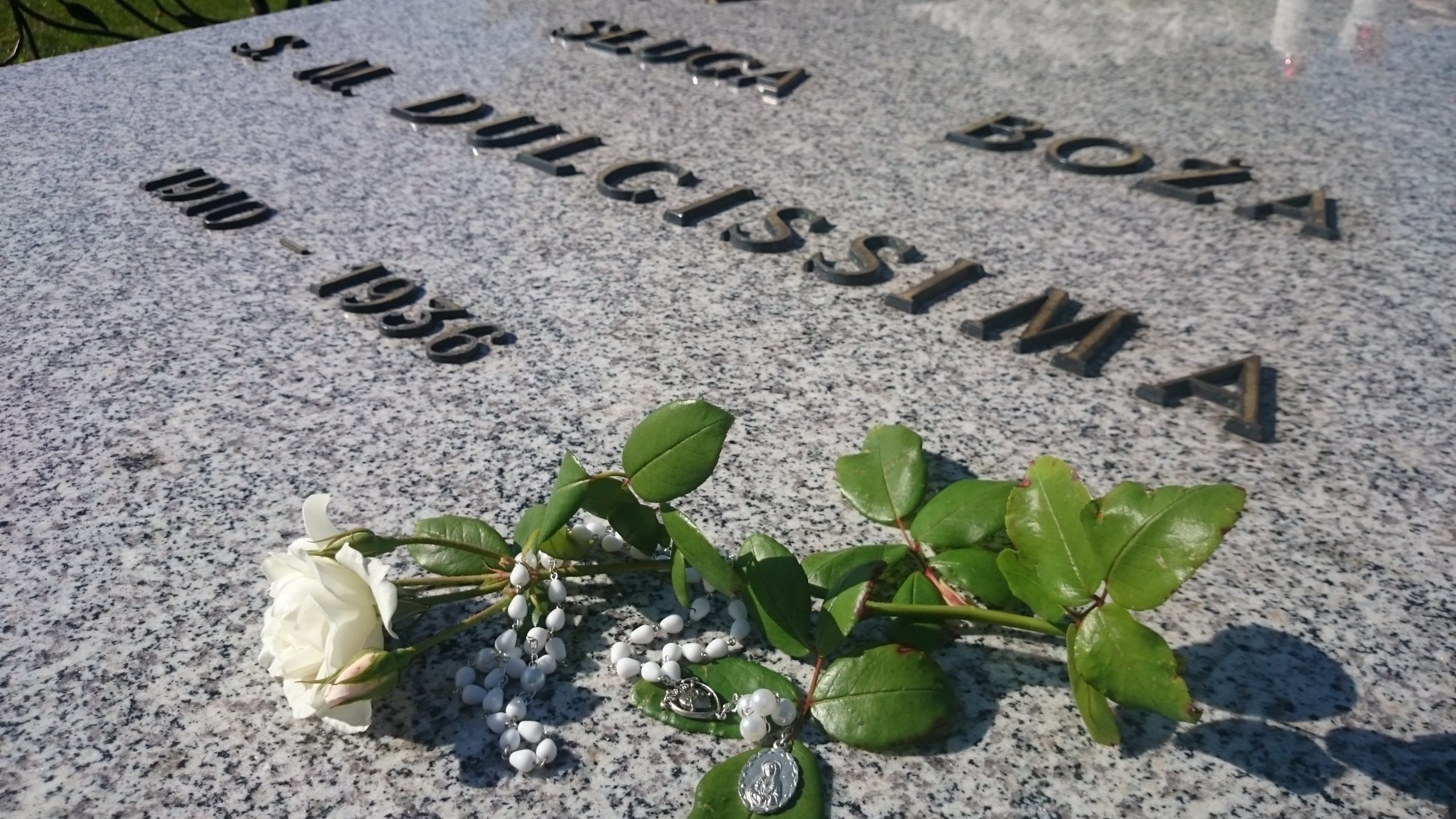
Helena Hoffmann was born two days before Popielec, on Monday, February 7, 1910 in Zgoda (Eintrachthütte), in today’s Świętochłowice district. She was the first child of Albina and Józef Hoffmann. Helena’s father was Józef Hoffmann, born on September 9, 1886 in Gąsiorowice (Gonschiorowitz). Historian, Fr. Joseph Schweter, CSsR, described his nationality as German. Józef was a Silesian from today’s Opole region, probably a traditional one, who spoke both German and Polish. Her mother was Albina Jarzombek, born on December 31, 1889 in Świętochłowice (Schwientochlowitz), to a family with a Polish orientation. In 1912, from this marriage, Reinhold was born – Helena’s younger brother. In 1916, the girl began studying at the 7-grade Public General School in Zgoda. As a schoolgirl, she was distinguished by a cheerful disposition and many abilities. Good memory and sharp mind allowed her to quickly learn both German and Polish; She also did not avoid Silesian dialect. Helena liked to learn, she easily gained new skills, she belonged to the theater club. From an early age, she liked to pray, appreciated the value of sacramental, often attended the Eucharist, and also had a passion for adoration and to the Blessed Virgin. The encouragement of her first confessor, parish priest Fr. Edward Adamczyk, to build a “chapel” in her heart for the Savior became for Helena the key to understanding her inner life.
Hoffmann’s first Holy Communion was made on May 5, 1921. After the celebration of the First Holy Communion, Helena, while digging in the field, came across a medallion depicting a nun holding a cross and roses. She didn’t know who it was. But – vaguely – she remembered that before her first confession she had dreamed of a similar figure and that she had been strengthened then. A little later, the girl in one of the religious magazines saw a photo of the same character. In one of Helen’s dreams she introduced herself to St. Teresa of the Child Jesus and from then on she systematically accompanied her in spirit. St. Teresa of Lisieux suggested her intentions to pray and to offer herself to God. In her dreams, she gave Helena, and later S. M. Dulcissima, spiritual guidance, inviting her to persistent prayers and sacrifices for the Church, Marian sisters and priests.
Helena Hoffmann entered the Congregation of the Sisters of Mary Immaculate in 1927. As a postulant, on October 23, 1929, in the Motherhouse in Wrocław, she received veil. Then she took a new name: Maria Dulcissima, received the habit and a white veil. She lived with other novices in the novitiate house in Nysa. In both cities, then located in Germany. In the novitiate, S.M. Dulcissima took up an interior struggle, accepted suffering as a gift, and continued to enjoy the “visitation” of St. Teresa of Lisieux. An important role in accompanying her in her illness was played by the spiritual director, Fr. Wincenty Groeger and S. M. Lazaria Stephanik SMI, a qualified nurse from Gliwice, who often witnessed her spiritual visions and meetings with the Blessed Mother, the Child Jesus, St. Teresa of the Child Jesus, The Guardian Angel, or the mystic Teresa Neumann from Konnersreuth in Bavaria. Immersing herself in prayer absorbed Sr. M. Dulcissima, while a deep and strong desire for union with God opened her paths to mystical meetings with her Bridegroom.
- M. Dulcisisma Hoffmann arrived at the religious house in Brzezie – a village on the Oder near Racibórz – on January 18, 1933. There she made herself known as a merciful Samaritan woman who accepted the requests and sufferings of people, offering them to God. The words: “Souls, Jesus, give me souls!” Became her favorite prayer! (…). Yes, I want to save souls, not so that anyone knows about it, but only you, my [Saint] Guardian Angel and Saint. Teresa “. In Lent of 1935, the Lord Jesus rewarded her total devotion to the mystery of the cross with the privilege and the felt charism of stigmata on her arms and legs, and soon also on her heart. St. Teresa of Lisieux accompanied her and said: “You must recreate Jesus completely in yourself.” The matters of the Church and the Congregation became very close to her heart. She prayed earnestly for the Holy Father, priests, men and religious women, the sick and the dead. Endowed with the gift of intercessory prayer and foreseeing history, she offered her sufferings in the current needs of the ecclesial community, both local and universal. She had ecstatic visions of the persecution of the Church in Germany and Bohemia; she experienced the attacks of the devil. The “Bride of the Cross” foretold the coming war, social unrest, and famines; heralded the coming plagues and diseases related to humans and animals. Mystical experiences led her to readily accept penance at all times for the sins of not only lay people but also priests and religious. Physically weak, immobilized in free pace.
Moving through paralysis, suffering from headaches, she fainted, but was able to pray for hours and offer her sufferings as compensation for sins. On Holy Thursday, April 18, 1935, she made her perpetual vows in the monastery chapel of the Brzezie.
Sr. M. Dulcissima Hoffmann trusted in God’s mercy to the end. Reconciled with God’s will, she died in Brzezie on Monday, May 18, 1936, four days before the Ascension of the Lord. This twenty-six-year-old girl came out to meet the Bridegroom with a burning lamp (Mt 25: 1-13). She joined Him at the appropriate hour in her beautiful life, in which she kept watch by her commitment to do good. Moreover, she was wise and prudent.
She found her burial place in the old church cemetery. The funeral of the “Bride of the Cross” became a manifestation of faith. The people of Brzezie, dressed in white on the day of the funeral, were convinced that their “holy nun” had died and immediately took the earth from the tomb, believing that this “relic” would protect them, their families and the houses in which they lived from all evil.
In 2000, her mortal remains were exhumed, secured and placed in a sarcophagus near the Brzeg parish church of the holy apostles Matthew and Matthias. The beatification process at the diocesan level of S. M. Dulcissima Helena Hoffmann began on May 18, 1999 in Katowice – exactly on the 36th anniversary of her death – and was completed after 20 years also on May 18, 2019 in Brzezie. From that day on, the matter of her sanctity of life was investigated by the Roman postulator – Dr. Giovanna Brizzi. For us, the “Bride of God” keeps pointing to heaven and interceding for us if we ask her to. It’s worth it.
Sr. M. Małgorzata Cur SMI
