
Aug 25, 2020 | NEWS
Religious vows express what is invisible to the eyes. It becomes mystical engagement with Christ to fulfill your vocation in the service of God and the Church and in striving for personal holiness.
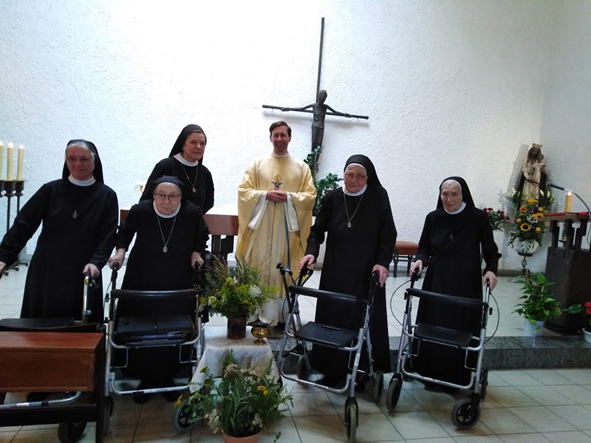
It is a tradition that each year in August and September are joyful months for sisters from the Tanzania Region doing religious celebrations.
After proper preparations and formation, successive groups of sisters make temporary or perpetual vows.
There is also great joy in the candidate community, because subsequent girls start the postulate whereby others join novitiate.
For two years there has been joy in the Silver Religious Jubilees.
Also this year, we are preparing for these events that will take place on August 28 the day of the feast of St. Augustine. However, due to the still existing pandemic threat, there will be celebrations that have a changed congregational character. All celebrations will be held in Chikukwe in one group. Unfortunately, sisters’ parents, family and friends will not be able to attend.
This year, five candidates will start their postulates.
Four postulants will go to the novitiate.
The temporary profession will be made by three novices: Sr. Emilia, Sr. Stephania, Sr. Marcelina
Four junior sisters will make their profession: Sr. Regina, Sr. Clelia, Sr. Inocencia and Sr. Teodora.
On this long-awaited day, we wish our sisters a beautiful wedding with Jesus Christ. Some will receive wedding rings, others a medal, others a habit with a white veil, and the candidates, postulants’ dress. Let these signs be to them daily from that day on, a reminder about God’s call and vows.
Our vow of chastity allows us to love God freely and serve all people.
By pledging to live in poverty, we express our desire to participate in poverty to
the Savior who became poor for us to enrich us with His poverty.
Finally, through the vow of obedience, we freely dedicate our will to God, and thereby we go deeper into the mystery of Christ and His plan of salvation.
By humbling himself in obedience, Christ shows us a more perfect way to love and worship the Father.
Let this day be a new beginning, a decision to never look back again.
Let our Immaculate Mother surround our sisters with her mantle of constant help.
Asking for prayer for our sisters,
Sr. Monika Kowarsz
Aug 23, 2020 | NEWS
Most of us are familiar with the custom of consecrating herbs on the feast of the Assumption of Mary (August 15). It is still common today, especially in rural areas. This custom has developed from several legends about the Mother of God. One of these legends tells that the apostles did not find her corpse after Mary’s death, but rather fragrant flowers and herbs that gave off an intense scent grew at the place of the grave. Perhaps this legend wants to remind us that the fragrance of the knowledge of Chisti should be spread through the life of Christians (2 Cor. 2:14). Just as Mary brought Christ through her life and thus salvation, the “being saved” in body and soul, so it should also happen through our life. The medicinal herbs are a symbol for this “healing”.
The sisters of our convent in the nursing center St. Hedwig in Cochem also celebrated a festive service on the day of Mary’s Assumption, during which herbs were also consecrated.
Because only a few residents were allowed to come to Holy Mass due to the corona regulations – the consecrated herbs were then distributed in the living areas.
Sr. Felicitas

Aug 19, 2020 | SPIRITUALITY
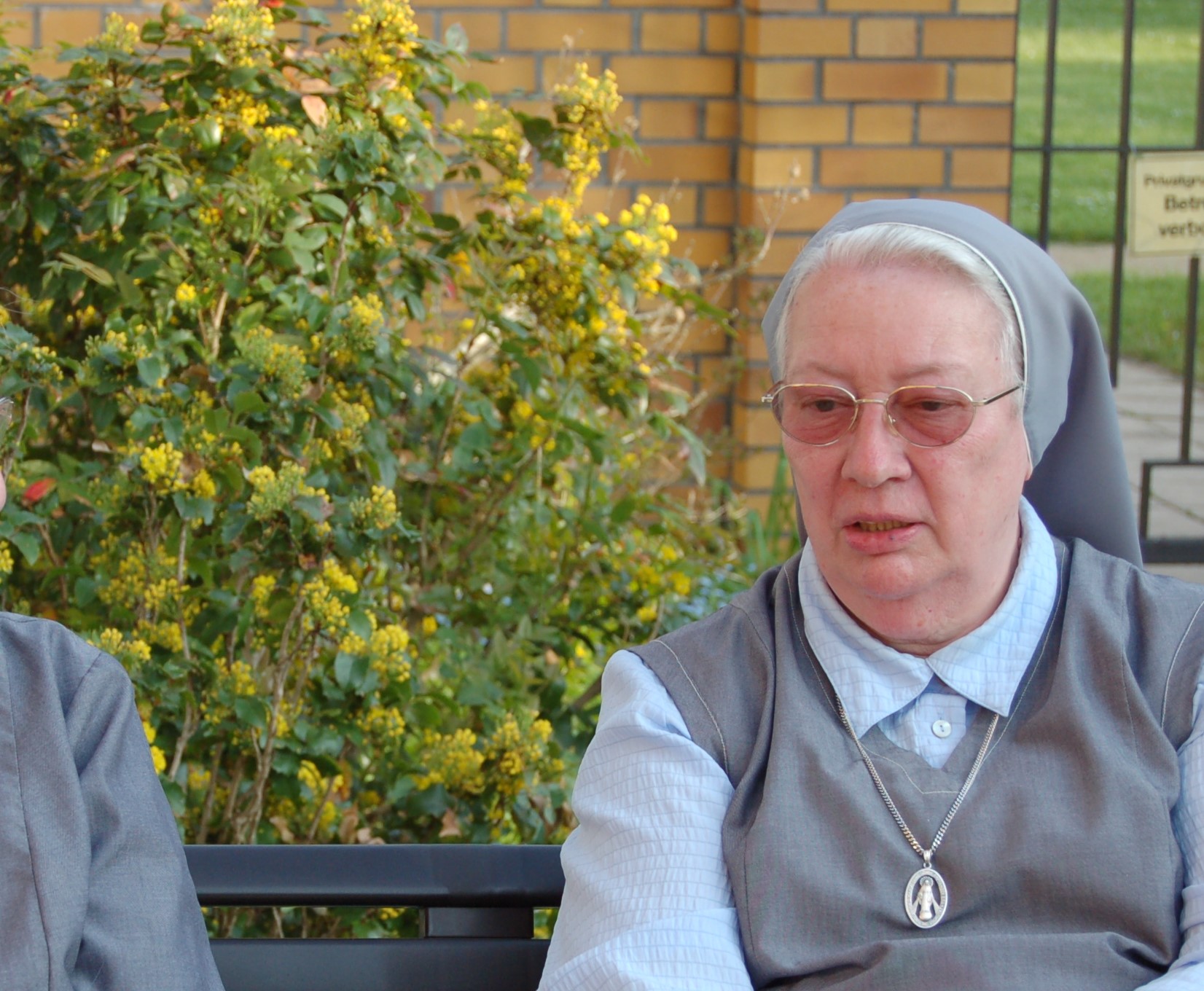
Every year in the August 23, we celebrate the Day of Remembrance of St. Rosa of Lima, which is one of our patron saints. She is one of the saints most of whom most of us do not know much about and thus have no special relationship with her. Some of us may have wondered why our founder so revered her and gave us as our patroness.
A few years ago, this led us in the German Province to deal with it a little more intensively on one sister’s afternoon.
In conversation with the sisters, we first gathered, what we knew about her:
- She lived from the end of 1586 to 1617 and was the first Saint of South America
- She belonged to the 3rd Order of St. Dominic
- She had mystical experiences
- She tried to convert people, especially young people, to a truly Christian life.
- She cared about the poor, the sick and the marginalized
- She fasted and forned a lot.
As we continued to study her CV, we came across some notable details that made us better understand her actions.
She was a child of Spanish colonists and saw how inhuman the Spanish conquerors were with the native Indians. She suffered from this and she was looking for ways to do something about it. As a woman, she was forbidden to preach, but she tried, “with heavenly eloquent, to win over all the people with whom she dealt, that she loved the virtues, but loathed the vices.” “This quote is from St. Antonio Maria Claret, who also honored St. Rosa.
In a contribution by Dr. Markus Büning I also found the following text on these thoughts:
“Blessed Pope Innocent XI (1611-1689) said of her (St. Rosa) the following remarkable sentences: ‘There was probably no missionary in America who would have achieved more conversions with his sermons than Rosa of Lima through her prayers and penitential exercises. ‘This is perhaps the key to understanding their self-castrations. Rosa was outraged by the lives of her Spanish compatriots in the colonies. Sexual debauchery, greed for gold and money, the contempt for the native Indians and the implausible way of life of many clerics were a thorn in her side. She intuitively sensed that with such a way of life, one cannot convince an Indian of the love of the Crucified One. On the contrary, the lives of the invaders were deterred and blocked the eyes of the locals on faith in the Redeemer. She wanted to demonstrate the program of contrast with her example: in poverty and in the mystical union with the Crucified One, she wanted to show the people of Peru who this Jesus really was.”
Here we can clearly see what St. Rosa has leaved us. There is still a great deal of inhumanity and injustice in our society today. Often, we can do something about this through our actions. But often our hands are tied and we are “only” left with the prayer and witness of our lives. Above all, we are called to mission with our lives, to be salt of the earth.
Antonia Maria Claret says: “Where has our missionary spirit remained? … Rosa expresses her displeasure at not being allowed to be apostolate herself. She would like to be allowed to move from country to country and proclaim the faith to convert all unbelievers. She would prefer to walk through the streets, the cross in her hand, clothed with a belt of penance, to awaken sinners with loud shouting and to make them repent.”
St. Rosa of Lima has become the patroness of Latin America, not through great works, but through her penitentness, her intimate relationship with Christ and her self-evident devotion to the poor. For me, and I think also for a large part of the sisters who took part in these meetings in Germany, she has become a model for our spiritual life and a true patron of our Congregation. She can teach us that we can only lead people to Christ’s love and follow through our lived example and the commitment of our own lives. Each of us, where we live and work, can become apostolate of everyday life and make it fruitful through works of love.
Sr. Petra Ladig
Aug 16, 2020 | HISTORY
Sr. M. Luka Spengler was one of the sisters who witnessed the move of the Generalate to Rome in 1970 and the early days there.
In the following text she tells from her memories:
Our trip to Rome began at the end of July 1970. We, Sr. Genovefa and I, first took the interzonal train from Berlin / West to Frankfurt / Main. We had to change there. Sr. Kuniberta joined us in Frankfurt, who had broken off her vacation to help with this not easy undertaking. We had a lot of luggage and it was not so easy to keep track, not to forget or lose any luggage. It was a long journey to Rome and we were glad when we finally drove into Rome.
We were supposed to be picked up there by sisters from another congregation, but no one was there. We had no choice but to wait, because we neither knew the language nor did we have money. And it was very hot!
After a long wait, the sisters finally came (I don’t remember which community they belonged to) and fortunately they spoke German. They took us to their house and there Mother Gertrud, the General Treasurer Sr. Florina and the General Assistant Sr. Doris, who had arrived by plane, were waiting for us. We stayed with the sisters for one night. The next morning the Vicar General Sr. Maria and Sr. Edda Krüger arrived in Rome by car from Berlin. Together we then drove to La Storta. There we had rented a house on the premises of the Dillinger Franciscan Sisters, which was to become the seat of the general government for two years.
The house we found was completely empty. The furniture transport from Germany was supposed to arrive in the course of the morning, but did not arrive until evening. So we had no choice but to wait in the Roman heat. We didn’t have anything and at least I got a chair from a nearby stable so that Mother Gertrud could sit on it. The rest of us sat on the steps and waited.
When the furniture transport finally came, it was late and we unloaded everything and only set up the beds for Mother Gertrud, Sr. Maria, Sr. Florina and Sr. Doris. The rest of us slept on the mattresses we had put on the floor. We didn’t put all the furniture up until the next day.
Until we (Sr. Genovefa, Sr. Kuniberta and I) took the train back to Germany, we stayed in Rome for about 3 weeks and experienced the early days and initial difficulties first hand. It started with shopping. La Storta is a bit outside of Rome and the nearest shops were far away and there was no bus. Mostly it was Sr. Doris who did the shopping and she was often taken away by Italian soldiers who were probably stationed nearby.
The Dillinger Franciscan Sisters, on whose grounds we now lived, were also very hospitable to us. They did a lot of farming and gave us fresh milk and eggs every morning. We were also able to take part in the Holy Mass there every day.
Language was a big problem in the early days. None of us spoke Italian. There were some misunderstandings, but they often made us laugh. For example, an electrician came into the house. It was hot and he always spoke of caldo, caldo. The nurse would always say, no, it’s hot. But we didn’t know that “caldo” means “hot” in Italian and that we always only understood “cold”.
Looking back, I can say that it was a difficult but also a very nice time and today I am grateful that I was able to help with the beginnings of our Generalate in Rome
Sr. Luka Spengler
Aug 16, 2020 | POSITIVE IMPULSES
We are sources of energy around us Because we are temples of God. So the quality of energy that comes out from us is likely to return in a similar form. It might not be from the same place or the same person but you get back what you give out from somewhere. So if you don’t like what you are getting, check what you are giving. Check your attitude, intentions, and feelings. Now get prepared to change the quality of the energy you give. We can give the energy of God or we can give the energy of our ego. The more you give, the more you get. Whatever it is.
Don Giorgio
