Nov 20, 2025 | DAILY BREAD
Thursday of week 33 in Ordinary Time
Reading: 1 Maccabees 2:15-29
The story in 1 Maccabees reminds us that fidelity to the Lord often requires courage, clarity, and decisive choices. When the king’s officials demanded that Mattathias and his family abandon their faith and conform to the imposed pagan practices, he refused, not out of stubbornness, but out of deep loyalty to the covenant. His faithfulness was not theoretical; it took the shape of action, sacrifice, and a willingness to stand apart from the majority. In a world where compromise can seem easier and conformity more comfortable, this passage challenges us to examine the hidden places where we might be silently giving in. Fidelity to the Lord is not simply saying “yes” to God once, it is a daily commitment to live according to His truth, even when it costs us convenience, reputation, or acceptance. God does not ask for perfection but for steadfast hearts that choose Him above all else. Faithfulness is the soil in which holiness grows. Let’s reflect: Am I willing to remain faithful to the Lord even when it demands difficult choices, or do I sometimes compromise my convictions for the sake of ease or approval?
Don Giorgio

Nov 18, 2025 | DAILY BREAD
Wednesday of week 33 in Ordinary Time
Reading: 2 Maccabees 7:1, 20-31
The courageous mother in 2 Maccabees offers one of the most moving testimonies of faith in all of Scripture. As she watches her sons face martyrdom, she does not cling to fear or despair but speaks to them of the Creator who made heaven and earth from nothing and who likewise brought each of them into being. Her gaze is lifted toward the eternal, and she invites her sons to look at creation with the same eyes of faith, eyes that see beyond suffering to the mercy of God who gives life and restores it. Her words reveal a love that is both tender and heroic: “Do not be afraid of this executioner… be worthy of your brothers… so that in the time of mercy I may receive you again.” This is the faith that transforms tragedy into hope, because it trusts in the God who created all things and who will gather His faithful ones again in the fullness of His mercy. Her example reminds us that real courage comes not from strength, but from a heart anchored in the Creator, certain that nothing done in fidelity is ever lost. Let’s reflect: Do I face life’s trials with the same trust in the Creator’s power and mercy, looking beyond present suffering to the eternal life God promises?
Don Giorgio
Nov 17, 2025 | DAILY BREAD
Tuesday of week 33 in Ordinary Time
Dedication of the Basilicas of Saints Peter and Paul, Apostles
Reading: 2 Maccabees 6:18-31
Eleazar’s witness in today’s reading is a stunning reminder that authentic love for God cannot coexist with even the smallest compromise. At ninety years old, he was offered an easy escape, not true betrayal, but mere pretence, a simple act of outward conformity that would save his life. Yet he refused even that illusion, saying such behavior “does not square with our time of life,” meaning that fidelity to God is not negotiable at any stage and certainly not at life’s end. His integrity flowed from a heart that knew God deserved truth, not appearances. On the feast of the Dedication of the Basilicas of Saints Peter and Paul, we recall two pillars of the Church who, like Eleazar, chose authenticity over convenience and truth over self-preservation. Their apostolic courage built the foundations of our faith; Eleazar’s fidelity shows that the same courage is asked of every believer. Temptations today rarely demand open denial—more often they invite pretence, subtle compromises, small concessions of conscience. Eleazar teaches us that even the appearance of infidelity diminishes the dignity of our love for Christ. True discipleship is transparent, consistent, and rooted in truth. Let’s reflect: Do I resist even the subtle temptations to “pretend” in my faith, choosing instead the clear, honest fidelity that honors Jesus with my whole life?
Don Giorgio
Nov 17, 2025 | NEWS
Panel on Sister Dulcissima Hoffmann at the Upper Silesian Pantheon
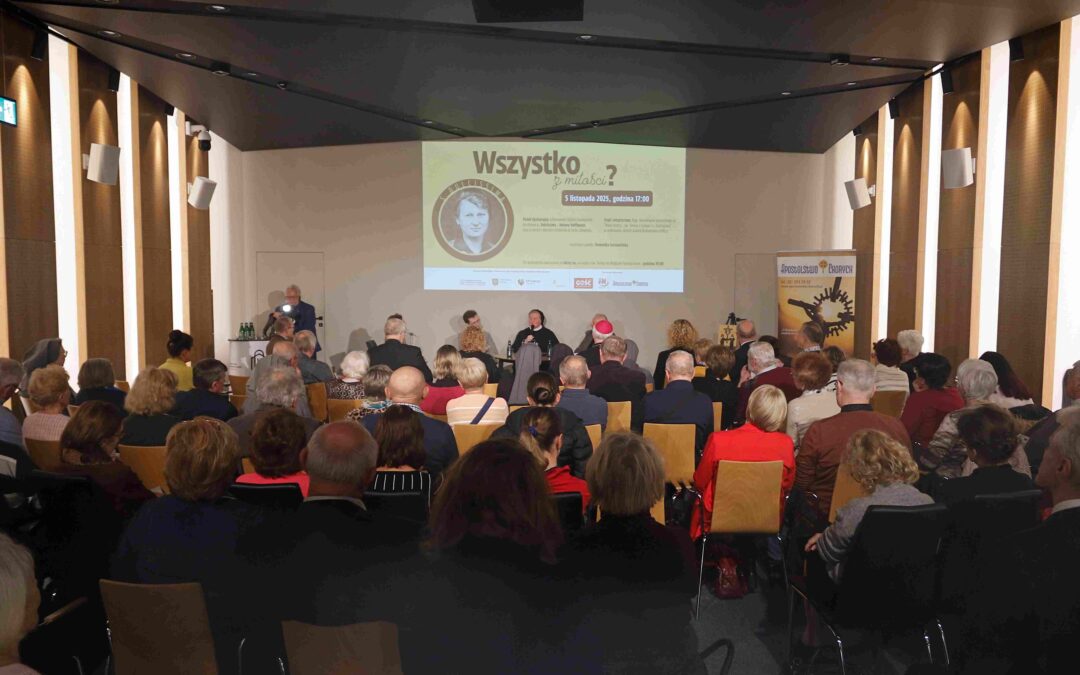
On November 5, 2025, in Katowice, at the headquarters of the cultural institution – the Upper Silesian Pantheon, located in the basement of the Archcathedral of Christ the King, a panel discussion entitled “Everything Out of Love” was held. The meeting was dedicated to Sister Dulcissima Hoffmann, one of the most moving and spiritually profound figures of the Silesian Church.
The event brought together numerous clergy, scholars, journalists, and faithful who wanted to deepen their reflection on her life, spirituality, and message. The meeting was part of the Archdiocese of Katowice’s jubilee year, celebrating its 100th anniversary, and its aim was also to support the ongoing process of beatification of Sister Dulcissima.
The event was initiated by Adam Kraśnicki, who has been associated with the Catholic Programs Department of Polish Television for many years. The panel was opened by Ryszard Kopiec, director of the Upper Silesian Pantheon, who emphasized the importance of remembering Sister Dulcissima for the spiritual heritage of the region.
The speakers included representatives of various fields—theology, philosophy, church history, and medicine—who introduced the participants to the phenomenon of the Silesian mystic’s spirituality. Their reflections showed that Sister Dulcissima’s message remains relevant and inspiring for contemporary people as well.
The panel was moderated by Dominika Szczawińska, who did not shy away from difficult and sometimes provocative questions – about the meaning of suffering, the image of God, and the human attitude towards extreme experiences when the Creator seems to “demand” suffering.
The spiritual and artistic complement to the meeting was the monodrama “Two Sisters” performed by Krakow actress Izabela Drobotowicz-Orkisz, with musical accompaniment by Dominika Salik. The 20-minute performance showed the spiritual bond between Sister Dulcissima and St. Thérèse of Lisieux.
After the performance, the actress emphasized:
“The adventure with Sister Dulcissima is one of the most beautiful. Her cry touched my heart deeply: ‘Jesus, give me the flight of an eagle. I don’t want to sit on the ground like a partridge.’” The juxtaposition of the thoughts of Sister Dulcissima and St. Thérèse helped the participants enter into the mystery of the cross—or rather, the mystery of love, which human beings are capable of even in suffering, if they can make it a gift offered to God and other people.
Barbara Gruszka-Zych, journalist and poet, drew attention to Sister Dulcissima’s extraordinary approach to everyday life and suffering:
“She taught that every day of life is a celebration. Even more, that even suffering can be a celebration because it is a gift from Jesus Christ, the Beloved. This is a great mystery and challenge.”
Prof. Henryk Olszar noted:
“Looking at Sister Dulcissima and reminding young people of her is a useful and commendable thing. Young people have their advocate in her.”
The meeting ended with a solemn Eucharist in the chapel of St. Thérèse of Lisieux at the Faculty of Theology of the University of Silesia, celebrated by Bishop Marek Szkudło. Prayer and contemplation were a natural conclusion to the evening, which symbolically united two spiritual figures—Sister Dulcissima and Little Thérèse.
The atmosphere of the entire event was full of reflection and gratitude for the spiritual legacy left by Sister Dulcissima Hoffmann.
The participants unanimously emphasized that the life of Sister Dulcissima Hoffmann is still a living source of inspiration—an example of courage, joy, and boundless trust in God.
S.M. Małgorzata Cur
Nov 16, 2025 | DAILY BREAD
Saint Elizabeth of Hungary, Religious
Monday of week 33 in Ordinary Time
Reading: 1 Maccabees 1:10-15, 41-43, 54-57, 62-63 41-43. 54-57. The reading from Maccabees presents a stark and heroic witness: there were men and women who preferred to die rather than profane the holy covenant. Their courage exposes the depth of fidelity that true faith demands, a fidelity that does not bend to pressure, convenience, or cultural trends. They knew that the covenant was not merely a set of rules, but their very relationship with God, the treasure of their identity. Saint Elizabeth of Hungary embodies this same unwavering devotion in a very different way: not through martyrdom, but through a life of radical charity, humility, and fidelity to the Gospel amid the temptations of wealth and privilege. Both the martyrs of Maccabees and Saint Elizabeth remind us that holiness often requires costly choices, choices that protect the sacred space of our relationship with God from anything that would dilute or dishonor it. Fidelity is not dramatic heroism alone; it is the daily willingness to choose God over compromise, love over indifference, truth over comfort. Let’s reflect: Do I value my relationship with God so deeply that I choose fidelity over convenience, even when the cost feels high?
Don Giorgio
