
Jun 15, 2026 | DAILY BREAD
Monday of week 11 in Ordinary Time
Gospel: Matthew 5:38-42
In today’s Gospel, Jesus invites His disciples to move beyond the logic of retaliation and enter into the logic of divine love: “If anyone hits you on the right cheek, offer him the other as well.” These words are not a call to weakness or passive resignation, but a revelation of the transforming power of God’s love. Human instinct seeks balance through revenge, repayment, or self-defense, but the love of God introduces a completely different way of responding. It breaks the cycle of violence, resentment, and hostility by answering evil not with more evil, but with goodness. This is precisely what God has done for humanity. Rather than responding to sin with destruction, He responded with mercy, forgiveness, and the gift of His Son. The Christian is called to participate in this same love. What makes the difference is not human strength or moral superiority, but the presence of God’s love in the heart. Only a person who knows he is deeply loved by God can respond to injury without being consumed by bitterness. The Gospel teaches that true victory is not found in defeating another person, but in allowing divine love to be stronger than hatred, pride, or the desire for revenge. In this way, the disciple becomes a living witness to the love that has already transformed the world through Christ. Let’s reflect: When I am hurt, offended, or treated unjustly, do I allow the love of God to transform my response, or do I remain trapped in the cycle of resentment, retaliation, and the need to repay evil with evil?
Don Giorgio

Jun 14, 2026 | DAILY BREAD
- 11th Sunday in Ordinary Time
Exodus 19:2-6; Romans 5:6-11; Matthew 9:36-10:8
The readings of this Sunday reveal a single and beautiful truth: everything begins with the love of God. In the Book of Exodus (19:2–6), God reminds Israel: “I carried you on eagle’s wings and brought you to myself.” Before any commandment, mission, or covenant, there is God’s loving initiative. Israel becomes a consecrated people not because of its merits, but because it is loved and chosen by God. Consecration is therefore a response to love already received. In the Letter to the Romans (5:6–11), Saint Paul proclaims that this love reaches its fullness in Jesus Christ. While we were still weak and sinners, Christ died for us. Through Him we are not only reconciled with God, but filled with joyful trust because we have experienced the perfect expression of divine love. In Jesus, God’s love for humanity becomes visible, concrete, and complete. In the Gospel (Matthew 9:36–10:8), Jesus sees the crowds with compassion because they are like sheep without a shepherd. He then sends His disciples to continue His mission. The Church is sent into the world not primarily to transmit ideas or regulations, but to announce the greatest truth every human heart longs to hear: you are loved by God. The mission of every Christian flows from having first experienced this love personally. We are consecrated because God loved us; we are reconciled because God loved us; and we are sent because God wants every person to know that they too are loved. To live as disciples is to allow this love to shape our lives and to become its witnesses wherever God places us. Let’s reflect: Have I truly accepted that I am loved, chosen, and reconciled by God in Jesus Christ, and does my life help others discover that they too are deeply loved by Him?
Don Giorgio

Jun 13, 2026 | DAILY BREAD
The Immaculate Heart of Mary
Saint Antony of Padua, Priest, Doctor
Gospel: Luke 10:1-9In today’s Gospel, Jesus sends the disciples ahead of Him with a simple but essential mission: “Whatever house you enter, first say, ‘Peace to this house.’” Before preaching, healing, or performing any other work, the disciple must be a bearer of peace. This reveals an important spiritual truth: if peace is absent, many graces remain unreceived or bear little fruit. God’s gifts flourish where hearts are open, reconciled, and at peace. A restless, divided, resentful, or conflict-driven heart often struggles to recognize the blessings already present. To be a man or woman of peace does not mean avoiding difficulties or denying problems; it means carrying within oneself the peace that comes from God and allowing it to shape every relationship and action. On the memorial of Saint Anthony of Padua and the memorial of the Immaculate Heart of Mary, we see two beautiful examples of this inner peace. Mary received God’s grace so completely because her heart was fully open to Him, while Saint Anthony became an instrument of grace because he allowed God’s peace and truth to dwell within him. The Gospel reminds us that before we can communicate God’s blessings to others, we must first become people whose hearts are anchored in the peace of Christ. Only then can the gifts of God truly bear fruit in our lives and in the lives of those we serve. Let’s reflect: Am I allowing the peace of Christ to dwell deeply in my heart so that God’s graces can bear fruit in me and through me, or am I letting unrest, resentment, and division diminish the gifts He wants to give and share through my life?
Don Giorgio

Jun 12, 2026 | DAILY BREAD
The Most Sacred Heart of Jesus – Solemnity
Reading: Deuteronomy 7:6-11; 1 John 4:7-16; Matthew 11:25-30
On the Solemnity of the Most Sacred Heart of Jesus, the Church contemplates the mystery of God’s love revealed in the Heart of Christ. In Deuteronomy (7:6–11), Moses reminds Israel that God chose His people not because of their greatness, but because He loved them. This love is deeply personal: God sets His heart upon each person and calls each one by name. In the First Letter of John (4:7–16), we hear the profound truth that “God is love.” The Heart of Jesus reveals the most powerful force in existence—not power that dominates, but love that creates, forgives, heals, redeems, and gives life. This divine love is stronger than sin, suffering, rejection, and even death. In the Gospel (Matthew 11:25–30), Jesus invites the weary to come to Him and learn from Him, “for I am gentle and humble in heart.” Here we discover that God’s love is also unconditional. The Sacred Heart does not love only the worthy, the successful, or the perfect; it loves first, loves freely, and loves without measure. The Heart of Jesus is therefore the meeting place of God’s personal, powerful, and unconditional love. Whoever enters into this Heart discovers not judgment but mercy, not oppression but rest, not fear but trust. The Solemnity invites us not merely to admire the Sacred Heart, but to entrust ourselves completely to the love that has chosen us, accompanies us, and never ceases to seek our salvation. Let’s reflect: Am I truly trusting and resting in the personal, powerful, and unconditional love of the Sacred Heart of Jesus, allowing His gentle and humble Heart to shape the way I see myself, others, and God?
Don Giorgio
Jun 11, 2026 | NEWS
Trip to Visit the Gypsy Children
April 25–30, 2026
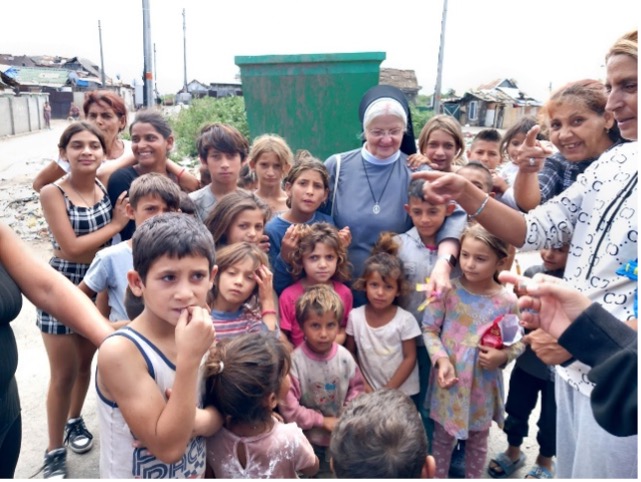
As always, the “Cologne Speedster” was loaded to the brim with donations. After Father Basilius gave us his blessing for the journey, Mr. Lingenthal and I set off (592 km). The trip went very smoothly, with perfect weather and no traffic jams. Our destination for the day was Neuhaus am Inn, and we arrived there safely…but then there was a small problem…there weren’t two rooms available for the night (even though they had been booked), but only one…so Mr. Lingenthal slept in the “Kölner Flitzer.” On Sunday at 5:30 a.m., we continued on toward Austria…because at that time, the border posts aren’t staffed yet. It was sunny again, the roads were clear, and we drove to Heiligenkreuz Abbey (256 km) for Holy Mass. I would have loved to stop by the monastery shop after the service—but when you’re traveling with men…you hardly have a chance for something like that…and that’s exactly how it was this Sunday. We drove on from Heiligenkreuz Abbey to Liptovský Mikuláš in the High Tatras (376 km). Early Monday morning, we set off again on our journey to Košice, the place Pope Francis visited in 2021. There, our interpreter Rado was waiting for us to drive together to the Caritas Center (65 km) in beautiful sunshine. Children and their mothers can come to the Caritas Center every day. They receive plenty of water and meals. The children who are not yet in school receive social guidance and are very well cared for. The children live with their families just about 100 meters from the center. The chapel was built by the Benedictines and their circle of friends right in the middle of the camp. Brother Lukas (+March 2026) designed it using his artistic talent. After visiting the chapel, all the children, of course, received a small treat again. I have rarely seen so much filth and poverty—but never, as always, so many grateful children. Unfortunately, the Benedictines from Maria Laach can no longer continue to be involved due to their age. But my benefactors in Cochem—to whom I am infinitely grateful—and I want to continue supporting this mission, even if it is more difficult for me from Berlin. But I think—it is in the spirit of our founder, whose 150th anniversary of his death we are commemorating this year—that solutions will be found. For whatever you did for one of the least of these brothers and sisters of mine, you did for me! Mt. 25:40
Sister Felicitas
