
Apr 12, 2026 | DAILY BREAD
Divine Mercy Sunday (2nd Sunday of Easter)
Readings: Acts 2:42-47; 1 Peter 1:3-9; John 20:19-31
On this Divine Mercy Sunday, the Word of God reveals that mercy is not an abstract idea, but a lived reality flowing from the Risen Christ. In the Acts of the Apostles (2:42–47), mercy takes the form of communion: the faithful live together, share everything, and allow love to shape their relationships. In the First Letter of Peter (1:3–9), mercy becomes a living hope: even without seeing Christ, believers love Him and rejoice with a deep and enduring joy. In the Gospel (John 20:19–31), mercy reaches its most intimate expression as Jesus stands in the midst of the disciples, showing His wounds, not as signs of defeat, but as sources of peace and forgiveness. To Thomas, who struggles to believe, Jesus does not reject but invites: “Put your finger here… doubt no longer but believe.” This is mercy, the Risen Lord meets us in our fear, our doubt, and our weakness, and transforms them from within. Divine Mercy is the presence of Christ who gathers, heals, and sends us, so that what we receive from Him becomes visible in how we live, love, and believe. Let’s reflect: Easter is receiving the mercy of the Risen Christ and living it in communion, faith, and love.
Don Giorgio

Apr 11, 2026 | DAILY BREAD
Easter Saturday
Gospel: Mark 16:9–15In today’s Gospel, the Risen Jesus appears to His disciples and entrusts them with a mission: “Go out to the whole world; proclaim the Good News to all creation.” The Resurrection is not only the moment of our salvation; it is also the beginning of our mission. The disciples, who were once fearful and uncertain, are now sent as witnesses of what they have encountered. Easter is not meant to be contained within personal experience, it must be proclaimed, lived, and shared. The joy of being saved becomes the responsibility to announce salvation. During the Easter season, we are reminded that to encounter the Risen Christ is to be transformed into a messenger of His life. Our faith cannot remain passive; it moves outward, reaching others through our words, our actions, and our witness. In Christ, we are not only saved, we are sent. Let’s reflect: Easter is embracing the new life given by the Risen Christ and being sent to proclaim it through our lives.
Don Giorgio
Apr 11, 2026 | NEWS
An Easter charity campaign for mission countries.
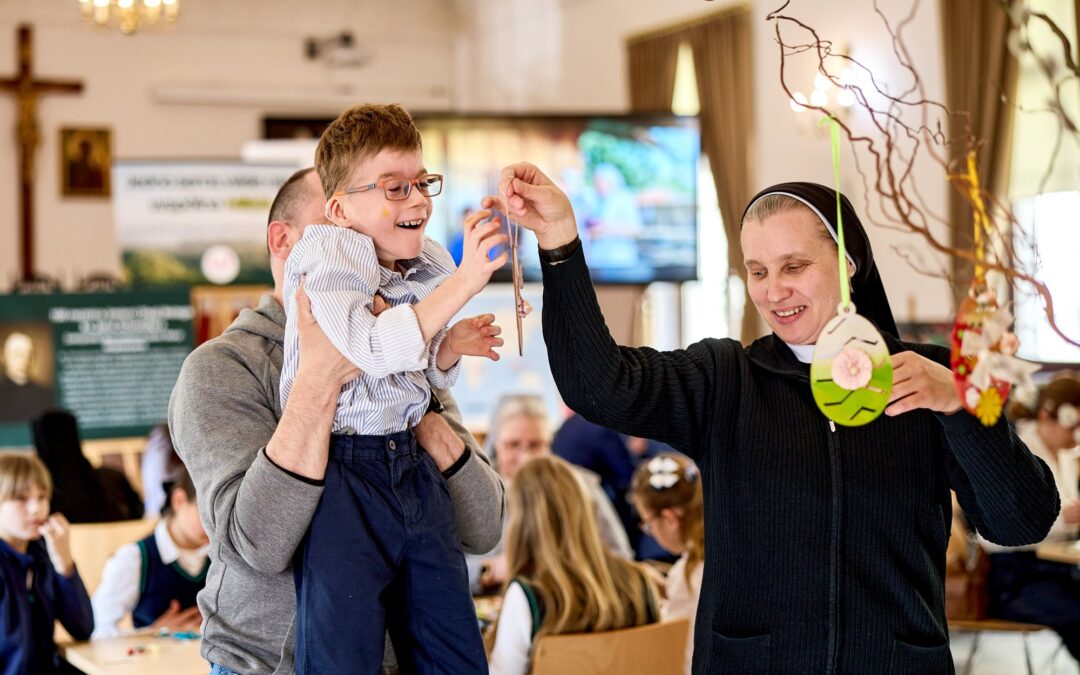
In an atmosphere of gratitude and joy, the finale of the charity campaign “One Heart, Many Hands – A Shared Mission,” organized by the Children’s Care and Treatment Center in Jaszkotl, took place. The event brought together numerous guests, partners, volunteers, and individuals committed to helping those most in need.
The idea to organize the campaign during this year’s Lent arose at a special time, as our Congregation commemorates the 150th anniversary of the death of Fr. Jan Schneider, a man deeply sensitive to the poverty and suffering of the most vulnerable, whose spiritual legacy we strive to uphold in the works we carry out in various corners of the world. The idea of a fundraiser for the missions run by our Congregation in Tanzania, the Philippines, and Indonesia arose from the desire to make the anniversary of his death an opportunity for concrete good, a living gesture of love and solidarity.
The culmination of the entire campaign was not only an opportunity to summarize the online fundraiser (which was very well received), but above all a moment demonstrating the power of community and solidarity. Thanks to the commitment of volunteers, donors, and partners, we were able to support specific aid projects in various parts of the world. In Tanzania, children will receive educational materials and the chance to learn; in the Philippines, the youngest children will receive birth certificates, enabling access to education and healthcare; and in Indonesia, women will be able to acquire a profession and secure the future of their families.
The highlight of the event was an Easter workshop, during which participants, among other activities, decorated Easter eggs together—a symbol of hope. The campaign’s finale demonstrated that even the smallest gesture matters, and that goodness—when shared—can multiply and bring true hope.
S.M. Franciszka

Apr 10, 2026 | DAILY BREAD
Easter Friday
Gospel: John 21:1–14In today’s Gospel, the disciples return to their familiar work, yet despite their efforts, they catch nothing. It is in this moment of emptiness that the Risen Jesus stands on the shore, though they do not immediately recognize Him. Only when they listen to His word and experience the abundance that follows does the beloved disciple exclaim, “It is the Lord.” This recognition changes everything, failure becomes fruitfulness, confusion becomes clarity, and distance becomes communion. The presence of the Risen Christ transforms ordinary life from within. During the Easter season, we are invited to cultivate this awareness: Christ is often present in the very places we consider empty or routine. The challenge is not His absence, but our recognition. When we begin to see with the eyes of faith and respond to His word, our lives are filled with a new meaning, and we too can proclaim with certainty: “It is the Lord.” Let’s reflect: Easter is recognizing the presence of the Risen Christ in our ordinary lives and allowing His word to transform everything.
Don Giorgio

Apr 9, 2026 | SPIRITUALITY
1. The Meeting of the Risen Christ and His Mother Mary
In the silent dawn of the Resurrection, before words are spoken and before the world awakens, the Son meets the Mother who never ceased to believe. In Mary, faith had already embraced the Resurrection even at the foot of the Cross. Now, the Risen Christ does not simply appear, He fulfills her hope. This encounter is not described, because it belongs to the deepest mystery of love: where sorrow has been total, joy becomes immeasurable. In Mary, the Church contemplates the perfect response to Easter, faith that remains, love that waits, and hope that is never extinguished.
2. The Meeting of the Risen Christ and Mary Magdalene (John 20: 11-18)
Mary Magdalene seeks a body and finds a living Presence. Her tears blur her sight, until her name is spoken: “Mary.” In that moment, recognition is born not from seeing, but from being known. The Risen Christ calls each of us personally out of our grief, transforming loss into mission. “Go and tell my brothers…”, from the garden of sorrow, she becomes the apostle of hope. With her, we learn that Easter is not an idea to understand, but a voice that calls us into new life.
3. The Meeting of the Risen Christ with Cleopas and His Companion (Luke 24:13–35)
On the road to Emmaus, disappointment walks slowly, weighed down by broken expectations. The Risen Christ draws near, not imposing Himself, but accompanying their confusion. He opens the Scriptures and their hearts begin to burn, yet they recognize Him only in the breaking of the bread. So too in our journey: Christ walks with us in our doubts, interprets our wounds in the light of God’s plan, and reveals Himself in the Eucharist. What was a road of escape becomes a path of return, and despair turns into proclamation.
4. The Meeting of the Risen Christ and Thomas (John 20:19–31)
Thomas stands at the threshold between doubt and faith, refusing to believe without touching the wounds. The Risen Christ does not reject his demand; He invites it. “Put your finger here…”, the wounds remain, not as signs of defeat, but as the eternal language of love. Thomas moves from skepticism to the highest confession: “My Lord and my God.” In him, we see that faith is not the absence of questioning, but the courage to let Christ enter our questions. The Risen One meets us precisely where we struggle to believe.
5. The Meeting of the Risen Christ and Peter (John 21)
By the shore, in the quiet simplicity of a shared meal, the Risen Christ restores Peter. Three times he is asked, “Do you love me?”, not to reopen the wound of denial, but to transform it into a confession of love. Christ does not define Peter by his failure, but by his capacity to love. “Feed my sheep”, mission is entrusted not to perfection, but to a heart that has been humbled and renewed. In Peter, we discover that Easter is the place where our past is not erased, but redeemed and entrusted with new responsibility.
G.P.
