

Spiritual Testament
When I speak at funerals, I like to ask if there is anything the deceased left us. By this I mean not so much money or material things, but a matter that was important to him and which should be continued in his spirit. So it is a spiritual testament. Superior General Sr. Sybilla In a letter written on the anniversary of the founder's death, on December 7, recalled this testament of Fr. John Schneider: "Stay united!" So it is about building and deepening unity. Today I would like to share with you three thoughts on this. Building unity Sr. Sybilla's letter, and with it the words of its founder, Father Johannes Schneider, remind us of something that is often quickly forgotten: unity is simply not present from the very beginning. It has to be created and built. By the way, this also applies to a lot of other things. An example of this comes from the area of kinship. When I am born into a large family, I have a brother or sister. For this relationship to develop into a brotherly or sisterly bond that enriches my life and is lasting and resilient for me even in difficult situations, siblings must also do something for it. They have to build relationships with each other. These thoughts can be well applied to a religious community. The promise of vows and the wearing of a uniform religious habit are not unity. This already shows that unity is not an external matter, but an internal relationship that binds people together. Watching over unity In the letter of Sister Sybilla, we are also asked to watch over unity. Thus, unity can be lost. From this point of view, our attention is required. Guarding or watching - I mean the people or objects being guarded. They are always the ones that are precious and important, and where there would be tragic consequences if they were stolen or lost. I would not and would not be watching over unimportant things. It only follows from this that unity is something very precious. It is valuable for our life together, and its loss would have negative consequences. Spiritual Exercise: What spiritual things are so precious to you that you should not lose them under any circumstances? What would you like to watch over? (And if you want to think more deeply, you can also ask yourself: What exactly is your attention?) Deepening unity We have just described unity as a relationship. Thus it is also subject to the laws governing every relationship, namely, it can change. It can get stronger, but it can also flatten and disappear completely. I can tell you about a beautiful example from the North Sea coast. The coastal people are in a never-ending fight against the sea. In their painstaking work, they try to pull a piece of land out of the sea. When asked why they do this, a Frisian once said, "You know, if we don't take the land from the sea, the sea will take it from us." Leaving it as it is not a solution. This picture quite nicely describes the concern of the founder, Fr. John Schneider. If I lean on oneness as I experience it, it will be lost. It will be my job to deepen it over and over again and keep it alive in this way. What this might look like in concrete terms would also be a good and valuable spiritual exercise. We will return to this topic (deepening unity) in later discussions. Prelate Dr. Stefan Dybowski 02/15/2021 Monatsvortrag Kloster St. Augustinus, Berlin-Lankwitz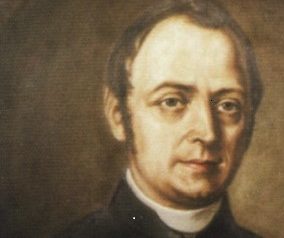
“Father Founder’s eyes”
It happens quite often to me that someone's very ordinary, unknowingly thrown sentence becomes the reason for deeper reflection. It was no different in the case that I will describe. And it was a simple, simple dialogue with an older Sister in my Community, whose memory is sometimes flawed. Looking at the picture with the image of our Founder, she asked me this: “Sister, did our Founder have glasses? Because I can't see. I replied that he hadn't. After a moment's thought, the sister says: “Aha… well, he had good eyes. This is why he is our Founder. Because he had good eyes. I had to reflect on this for several weeks. I made three conclusions for myself. First of all: Father Founder had good eyesight (I mean not physically good eyesight, of course), ie he saw a lot. Certainly more than me. He saw the enormity of the needs and poverty (not necessarily material) of his contemporaries. I ask myself the question: do I strain my eyes to see something more than my little, safe world (my proverbial "tip of the nose")? Do I see the changing needs, problems and "poverty" of my contemporaries? Do I not wonder about the empty eyes of people on the tram and their ears stuffed with headphones? Is it not worrying that many young people are lulled of reason? Are you not worried about the very distinct divisions in society, in families and communities? Do I see anything more in such everyday pictures? Am I looking for reasons? Father John saw more, wider, deeper. That is why he responded adequately to the needs of the situation… and innovative for the 19th century. And I? I regret to say that most of the time it is easier for me to follow my well-established, proven patterns and not ask Jesus: "What would you do?" Second: Father Schneider literally had "good eyes". Do I also have a good eye, "God's eye"? Do I try to see other people with God's eyes? Do I see in it the beauty and goodness of God's child? After all, everything that God created was good. Am I helping people to dig out the light they were born with? After all, this light fights so hard in each of us not to go out completely… Am I shielding this smoldering wick? Not only in the other person, but also in myself? Third: he had "enlightened eyes of the heart" and knew "what is the hope to which God calls, what is the riches of the glory of his inheritance among the saints, and what is his overwhelming power for us believers - based on the action of his power and strength." (Eph 1: 18-19). He gave others what he had, that is, strong faith, hope and love - the inner certainty of God's Mercy ... free, for everyone without exception. This reminds me of a simple rule: you give what you have in you. What am I giving to others? If I have no light in me, how can I light the way to God for others? Each child adopts some of his parents' qualities and learns from them by example. Am I a real spiritual daughter of Fr. Schneider? Have I taken over his legacy? I am still far from that. I think my eyesight is poor, so I need treatment at the DIVINE OPHTHALIST ... Sr. Franciska Jarnot
Unity is colorful
Uniform - Fascinating images Everyone knows such paintings: boys' choirs in uniform festive costumes, athletes in uniform sports outfits, soldiers in uniforms. This is already something: 20, 50, 100 or even more people wearing the same clothes. They are all uniformly dressed. It reminded me of a diocesan pilgrimage to Rome, where over 1,000 of the faithful had entered St. Peter dressed in yellow scarves. Immediately, associations like community, strength come to my mind. I would like to belong to it. The external image often tempts us to attach the unity of the community to external things. Wearing the same clothes suggests the same habits, same preferences. And when the other person thinks and acts differently, the surprise is great. I did not think so ... Unity is not uniformity In order to understand unity and then want to live it, one must first of all realize that unity is not uniformity. First I will deal with the realm of facts. The mountain meadow looks gorgeous. If you come closer you will see flowers and grasses of very different shapes and colors. The symphony consists of a multitude of different sounds produced by different instruments. Diversity: a hallmark of our Church Pentecost: Many peoples gathered in Jerusalem at that time, each hearing the apostles preach Jesus' message in their own language. Diversity among the Apostles: Only in the circle of the apostles can one see diversity: Peter and Paul, James and John - and the Bible tells us that the apostles also fought fiercely with each other on some matters (circumcision, keeping the Jewish law). Paul: Many gifts of grace and one Holy Spirit In 1 Corinthians, Paul describes the diversity in the church. He talks about the various gifts of grace he experiences in the church. He uses the Greek word "charisma" (the word "charming" is derived from it). Do you know the charisms (gifts, talents, abilities) of others (your family members, sisters, associates ...)? It could be exciting (though not easy) to exchange ideas on this topic. Paul sees a great enrichment in diversity, but also a danger, for example in the formation of small groups or divisions. Therefore, he calls for unity (1 Cor 1: 10-17). One body and many members Paul compares the variety with the image of the human body: one body but many members. Not only each member has a role and is important, but even each member is necessary ("The head cannot tell to the feet: I don't need you!"). Anyone would agree to that immediately. But the reality is different. Time and time again there are divisions in the world (past and present): "We don't need him / her." (foreigners we do not need; children we do not need in worship ...). Reflective question: Can you find Corinth in my life (in our monastery, in my family ...)? Unity has a purpose Image of the human body can help us understand unity. Because the unity of many limbs has one goal: life. Especially in our body, we feel very quickly how much life is in danger when the limbs fail (sprained foot, headache). Thus, unity does not just result from uniform appearance or uniform rules. They can indicate that everyone has a common goal. In the case of athletes it is the will to win that binds them together, in the case of singers it is the joy of music. One spirit The image of the human body can also be well applied to a community. The external uniformity (religious habit, common prayer life) is a sign of a common goal that unites them - despite the individuality of their members: they want to serve life. This applies to both physical and spiritual life, the life of the individual, as well as the life of the community. And those who serve life also serve and give glory to God. There are many examples of this in the Scriptures, such as "Whatever you did to one of my brothers and sisters, you did to me." (Matthew 25:40); or "I have come that they may have life and have it fully." (John 10:10). This is what Paul means when, in the diversity of the members, he speaks of one Spirit who animates all. Prelate Dr. Stefan Dybowski 01/18/2021 Conference for the day of recollection at the monastery St. Augustinus, Berlin-Lankwitz
25th World Day for Consecrated Life
Pope Saint John Paul II instituted a day of prayer for women and men in consecrated life. This celebration is attached to the Feast of the Presentation of the Lord on February 2nd. This Feast is also known as Candlemas Day; the day on which candles are blessed symbolizing Christ who is the light of the world. So too, those in consecrated life are called to reflect the light of Jesus Christ to all peoples. Three reflections to share: 1. Consecration is a liberation through faith from our personal plans to embrace the plan of God. In the life of St. Joseph, we see it very clearly. He had his own personal plans but after the apparition of the Angel in the dream, “he did as the angel of the Lord commanded him”. This is a constant process in our life. Standing above our personal plans to be an instrument of His plan. No other plans, Jesus is my plan! 2. Consecration is embracing with hope the present situation to make it the best place for Jesus Christ to be present. Here also we see in St. Joseph a model. There was no place in the inn, instead St. Joseph prepared a manger. Wherever we are, our consecration gives us the hope to make a place for Jesus. Kings or shepherds, they will find in our witness, in our joy, in our being, the good news of Messiah. No doubts, Jesus is my joy! 3. Consecration is becoming love to be the light to guide those around us according to the plan of God. The image of St. Joseph, leading the Holy Family is before us. Becoming love happens in our personal relationship with God who becomes our love. In that love, we know when to flee to Egypt and when to go to Nazareth so that our only Love, Jesus is alive in us. No compromises, Jesus is my treasure! Don Giorgio
The word of God has no lockdown
On the occasion of the "Day of the Word of God", which Pope Francis introduced in 2019 and set for the 3rd Sunday of the annual cycle (this year it is January 24th), I would like to tell you how we have been in our convent, for some time Design Bible meetings. We meet once every week and in Advent 2020 we started a new form of Bible sharing, which at first seemed a bit strange to us, but increasingly we like it more and, above all, is spiritually enriched. The special thing about these meetings is that the sister who takes over the leadership (each time a different sister is on it) does not have to prepare especially for it and read comments on the chosen Bible text. She only leads the sisters through the meeting step by step and, like everyone else, lets herself be guided and inspired by the Holy Spirit. When we first met this new method, we decided to work through the Gospel of Matthew section by section so that each sister knows where to go next. And it is already clear to us, although we are still in the initial phase of this form of work, that through this we better and more deeply understand the fullness of the intention of Matthew, who wrote his Gospel primarily for Jewish Christians and therefore refers a lot to the Old Testament teaching. We sense something of God's plan of salvation with us humans. The steps of this method are simple:- As with any Bible sharing, we begin with prayer
- 2. Reading the text
- I would like to explain this third step in more detail, as it is a little unfamiliar. The participants are invited to ask questions about the text. It can be questions of understanding, but above all questions that seem simple-minded or not very useful at first glance. For example, during the Christmas story in Mathew we asked ourselves: What did Mary think when Joseph was told in a dream to flee to Egypt. Didn't their faith in the love and providence of God waver? Or what did Joseph feel when the angel told him to take the pregnant Mary as a wife. Wasn't that an imposition to a young, unmarried man? Or: What did Mary and Joseph do with the gifts of the three wise men ...
- Division of the text into sections of meaning - This step also requires some explanations. You can divide the chosen section according to chronological order, for example in the case of Joseph's dream that he should take Mary to himself, the division into what happened before, during and after the dream would be possible. But you can also use the people involved as a classification criterion or other criteria ...
- In this step, the individual text sections are processed. Here you will find that some of the questions you asked in step 3 are answered, while others have become unimportant. - I would like to use a picture here: The individual steps are like a ditch in the earth. You start on the surface and step by step you get more in depth and a personal encounter with the word of God.
- 6. What does God mean to me today with this passage? - At this point we are able to experience that in the course of the meeting each sister becomes naturally clear where in this passage of the text the call of God is for her.
- 7. The conclusion of the meeting develops naturally with a prayer formulated personally by each sister. This can be a thank you, a request for strength and help in the near future, a prize or something similar.