My first encounter with the Miraculous Medal

My first encounter with the Miraculous Medal

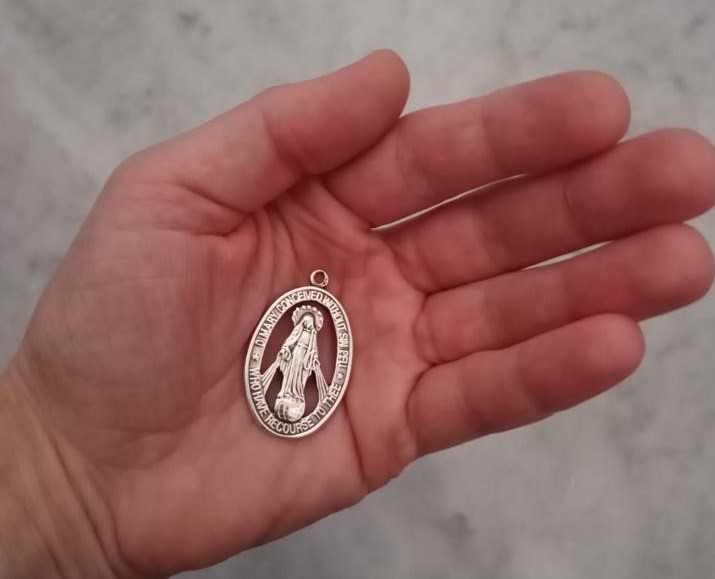
It happened when I was 15.   The days of my teenage life passed fast and intense, they were filled with science, with fun, meetings with peers and help at home. Like every teenager, I also wanted to replace my wardrobe from time to time, unfortunately due to the fact that in my family we did not have much money, clothes purchases were rare and really for  great events. And such a circumstance happened to me. One day I went shopping for pants. Going from shop to shop,  I could find anything suitable. I knew I had to buy what would be suitable for various occasions. Weary of the long search, I decided to enter the last shop with the thought that "if I find nothing here, I will return home". I even liked one pair of pants, so I took them off the hanger and went to the fitting room. Unfortunately, the pants turned out to be too small. Worried that nothing I managed to find  and I go home with nothing, I started getting dressed, and suddenly leaving the fitting room, I noticed that there was "something" on the ground. I bent down and I picked it up. It was  a medal with the figure of Mary. The medal was large, not as tiny as is usually worn around the neck. Surprised by what I found, I began to look around anxiously if someone might have been around has lost it. I didn't see anybody. After a while I asked the saleswoman whether maybe she lost such a medal, but she replied "no" and since it was me who  found it, it's mine and I can take it. Returning home, I looked at it for a long time, wondering who was carrying such a big medallion? and how did he get there? ”. After returning home, I did not show anyone what I found. At that time I also thought that "no one normal wears such a big medallion around her neck, and when it is, it's a devotee, ”which is why I didn't want it either hanging around my neck, I just removed it away, and every now and then took it out and I watched, sometimes wondering how it happened that when I entered the fitting room I didn't see it and what does it all mean. Over time, I  forgot completely about the medal I found and the whole story. Years passed. When I was 20, I decided to enter the Congregation and then a thought appeared  "but of what?". For this intention, I went on a walking pilgrimage to Częstochowa. There from the Vocation Center, I took several flyers, including our Congregation. In my heart I felt that it should be the so-called Marian Congregation, but also as a young girl, I paid attention to the dress of the sisters "by no chance it was not built up too much”. Looking at the flyer, it caught my attention. It said that the Sisters wear the Miraculous Medal, its photo was also posted. I made this story  because it reminds me of something. After returning home, I found the "treasure" of previous years and compared with the photo I saw in the flyer were different. The one which I had, had "holes" and the one the sisters were wearing was "full". Despite that I noticed this difference as a sign of where I should go. After joining the congregation I got to know the symbolism and meaning of this medal. I also found out  to my surprise and joy that the sisters in Africa and Germany wear  the same medal as I found years ago. Since then, the Miraculous Medal accompanies me every day, as does each of us.   I admit that I often forget about it, and  feel guilty that I don't wear it perhaps with the honor that is due to it, but I always make a novena before its memory, everyday I try to kiss it reverently, offering my life to Mary and looking at her, as I did when I was 15 and then not knowing that finding pants on that day wasn't as important as finding a Wonderful mental. This medal  was one of the signs that the Congregation I am in is my true place, and the once "great" medal that maybe someone "died" was supposed to wear, I wear it on my breast with pride and without fear.   Sr.M. Noemi Stanilewicz SMI
St. Rosa of Lima – the “unknown” Patroness of our Congregation!?

St. Rosa of Lima – the “unknown” Patroness of our Congregation!?

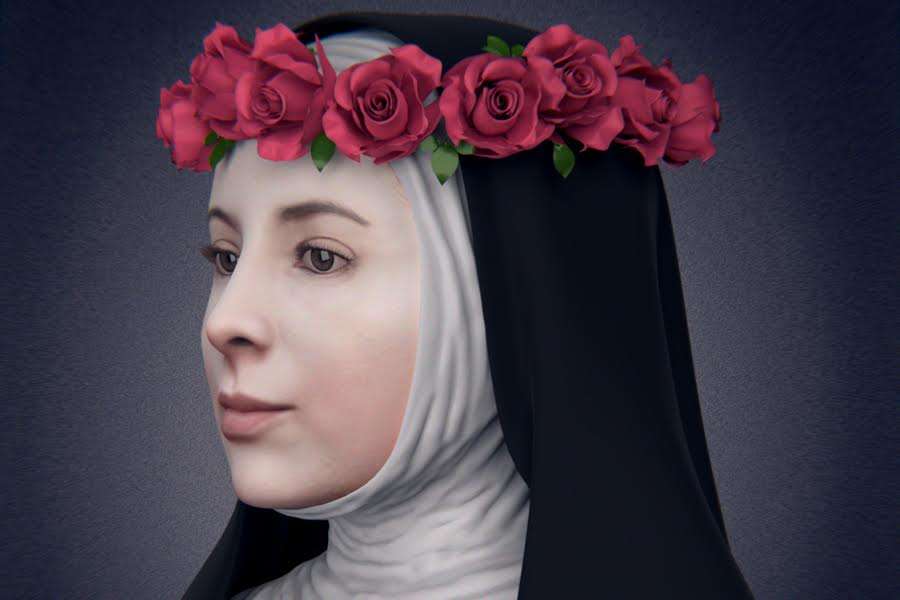
Every year in the August 23, we celebrate the Day of Remembrance of St. Rosa of Lima, which is one of our patron saints. She is one of the saints most of whom most of us do not know much about and thus have no special relationship with her. Some of us may have wondered why our founder so revered her and gave us as our patroness. A few years ago, this led us in the German Province to deal with it a little more intensively on one sister’s afternoon. In conversation with the sisters, we first gathered, what we knew about her:
  • She lived from the end of 1586 to 1617 and was the first Saint of South America
  • She belonged to the 3rd Order of St. Dominic
  • She had mystical experiences
  • She tried to convert people, especially young people, to a truly Christian life.
  • She cared about the poor, the sick and the marginalized
  • She fasted and forned a lot.
As we continued to study her CV, we came across some notable details that made us better understand her actions. She was a child of Spanish colonists and saw how inhuman the Spanish conquerors were with the native Indians. She suffered from this and she was looking for ways to do something about it. As a woman, she was forbidden to preach, but she tried, "with heavenly eloquent, to win over all the people with whom she dealt, that she loved the virtues, but loathed the   vices.” “This quote is from St. Antonio Maria Claret, who also honored St. Rosa. In a contribution by Dr. Markus Büning I also found the following text on these thoughts: "Blessed Pope Innocent XI (1611-1689) said of her (St. Rosa) the following remarkable sentences:  'There was probably no missionary in America who would have achieved more conversions with his sermons than Rosa of Lima through her prayers and penitential exercises. ‘This is perhaps the key to understanding their self-castrations. Rosa was outraged by the lives of her Spanish compatriots in the colonies. Sexual debauchery, greed for gold and money, the contempt for the native Indians and the implausible way of life of many clerics were a thorn in her side. She intuitively sensed that with such a way of life, one cannot convince an Indian of the love of the Crucified One. On the contrary, the lives of the invaders were deterred and blocked the eyes of the locals on faith in the Redeemer. She wanted to demonstrate the program of contrast with her example: in poverty and in the mystical union with the Crucified One, she wanted to show the people of Peru who this Jesus really was." Here we can clearly see what St. Rosa has leaved us. There is still a great deal of inhumanity and injustice in our society today. Often, we can do something about this through our actions. But often our hands are tied and we are "only" left with the prayer and witness of our lives. Above all, we are called to mission with our lives, to be salt of the earth. Antonia Maria Claret says: "Where has our missionary spirit remained?  ... Rosa expresses her displeasure at not being allowed to be apostolate herself. She would like to be allowed to move from country to country and proclaim the faith to convert all unbelievers. She would prefer to walk through the streets, the cross in her hand, clothed with a belt of penance, to awaken sinners with loud shouting and to make them repent." St. Rosa of Lima has become the patroness of Latin America, not through great works, but through her penitentness, her intimate relationship with Christ and her self-evident devotion to the poor. For me, and I think also for a large part of the sisters who took part in these meetings in Germany, she has become a model for our spiritual life and a true patron of our Congregation. She can teach us that we can only lead people to Christ’s love and follow through our lived example and the commitment of our own lives. Each of us, where we live and work, can become apostolate of everyday life and make it fruitful through works of love.   Sr. Petra Ladig