We are building something good
Something good… what? Recently, I had the opportunity to do my novice internship at the Center for Women of the PoMoc Association in Katowice, run by Sr. Anna, Sr. Barbara and Sr. Karolina. Amidst the time of prayer together, accompanying the women and their children at the Center, and many creative activities, I have discovered that the house is full of the abbreviation BCD. What does that mean? I started to wonder. Of course, the Sisters rushed to help. We are building something good. Is it just a building erected at the Center? Is it just an action to raise funds for the next stages of construction? No! There is something much more behind this shortcut! BCD is a community that, for the glory of God, wants to build something good. Something? World! This world that is available to each of us, the world we are a part of, because it is the place where God has placed us. The goal is to oppose evil, physical and psychological violence, wounds, and torn relationships. How to do it? You have to start with the basics. That is, from building the right relationships for which we are created, because it is natural that we are simply drawn to another It is in families that good is born, acceptance of man, acceptance of him. Based on lasting intergenerational relations, we can create a society filled with a sense of security and mutual support, and make that the chain of misunderstanding and conflict will be broken. And this is the destiny of the St. Joseph at the PoMoc Association and the priority of the whole community # building good to create healthy relationships in families. And the most interesting thing is that it is already happening! The BCD team does not wait for the "headquarters" in the Center, where the workshops and meetings will be held, to be ready. They meet today - mothers who exchange experiences, fathers who want to experience their parenthood better, and a multitude of volunteers who not only work for the Center, but bring to this community all that they have the most valuable - themselves. Each of us can become part of the #budujemycosdobrego team. Not only with real cooperation in Katowice with my sisters, but where we are - in our families, in our communities, in our workplaces. Because the point is that the good that we can pass on goes with us everywhere. Sr. Justyna Wijatyk (novice)News from the Philippines
In the Philippines, since February, we have the 2nd degree of epidemiological threat, which is already much milder. However, children still do not go to school, there is still distance learning. From February 10, after two years, the borders of the Philippines have also opened for tourists, and although people still suffer from Covid, everything returns to normal in small steps, but not like in Europe. On February 1, we started the monthly "FEEDING PROGRAM" - feeding children in the Payatas district. It is one of the poorest neighborhoods in Manila, only a few minutes from our home. Unfortunately, due to Covid it is not yet possible to keep the normal Feeding program as it was before; that is, the children have joint educational activities, catechesis, games and a meal. Every day, from Monday to Friday, the mothers of these children prepare a warm, wholesome meal for their children, and we supervise the work. At noon, children receive a cup of milk or cocoa, a hot meal and fruit. The mothers of these children learn how to properly nourish their children. There are 50 children enrolled in the feeding program, but in fact many more come, often around 80. We try to ensure that there is enough food for all children, because it is difficult to refuse a hungry child a bowl of rice. We received funds for feeding our children from the parish of the Philippines Fathers in Chioggia, Italy. As soon as we come to Payatas, the children run up to us, greet us and put our hands to their foreheads saying "sister bless" which means "bless me". Through those children we already know, we get to know their families and their problems. We visit them every now and then, and if necessary, we help as far as possible. Sometimes this help is simply giving children intestinal worm medicine or other medications. We also convince parents of the importance of taking care of their health and healing themselves. Some people here are afraid of going to the doctor mainly because of the cost of treatment, which is very high here. Even though almost all of them are Catholic, most people in Payatas do not practice their faith. They don't go to church; they don't take the sacraments. Bearing this in mind, we always try to encourage all families to participate in the Sunday Mass, to pray the rosary in the family and the need for closeness with God in everyday difficult life. We also often help in completing the formalities related to the sacrament of children's baptism. In January, we helped six preschool and school children to be baptized. Many children do not have a birth certificate and therefore do not go to school. The procedures for obtaining a birth certificate are quite complicated, and the parents of these children are often illiterate. We help them with these procedures as much as possible. We make parents aware that education is important and thus children have a chance for a better future. The restrictions related to the pandemic limit us in our actions, but we trust that with God's help this pandemic will end and we ask God for this in our prayers. In closing, I am asking you to pray for us and for our missions here in the Philippines, so that we may develop the work of our Founder here and that we may have many vocations. With heartfelt greetings and prayers for all those who support us spiritually and materially. S.M. Agata SobczykJoy, Happiness and Smiles abound in the Region of Tanzania.
Finally, the long-awaited day has finally arrived. It is many years since the name Schneider began to be heard on the African continent, especially in Tanzania. When we thank God for the great things He does for us in life we have every reason to say a word of thanks to all who made this Schneider name continue to be heard in every corner of the soil of our Region of Tanzania. It is a great pleasure and joy to reach the climax and the very day to be able to bless our new and wonderful John Schneider English Medium Pre & Primary school, which many have dedicated their efforts up to this point. To this day the joy that has reigned in our hearts is thanks to God for the congregation and all who in one way or another has been the reason for the existence of this school. First of all, thanks to the leaders of the congregation, previous Mother General Sr. Alma Białek and her Council, the superiors of all our Provinces as well as our Region of Tanzania for their great efforts to ensure that Schneider School is built in Mwanga. Thank you very much Mother General Sr. Sybilla Kołtan on behalf of all the superiors of the congregation who made their contribution by providing us with this great school support. Secondly sincere thanks to the economist of the congregation Sr. Luka who has always been at the forefront of helping us economically in the construction of this school. God bless you always. When we thank God for the gift of school, it is our only opportunity to thank and congratulate the school leadership, all the staff and John Schneider’s students for their professional, ethical, and heroic efforts in their school formation, and especially in their examinations. The first fourth grade since the school started, have been able to do wonders in their performance, with the achievement of grade A, thus gaining first place District, first in the Region and within Same diocese are the only successful Catholic school. very nice. We thank God for that. This joy of good performance has led to our school being awarded the Certificate of Excellence in the Diocese by the Rev. Father Bishop Rogath Kimaryo and the entire district Education department. For us it is a great pleasure for our John Schneider school, our Region of Tanzania and the congregation as a whole. God bless all those who support us economically and in other ways until we can shine like this and today on.04.02.2022 we were able by the grace of God to bless and officially open our school. Thanks to all the Sisters wherever they are and in every corner of the world where you are for your prayers and sacrifices that you offer always for us and especially for the construction of our John Schneider school in Mwanga Special thanks also to all the donors of our congregation who support and enable us. God bless you and we always pray for you in our prayers and intentions of the mass. Thank you very much. Sr. Agnes - Regional Superior -Tanzania
Tanzania (Part 3) Nanjota (since 1976)
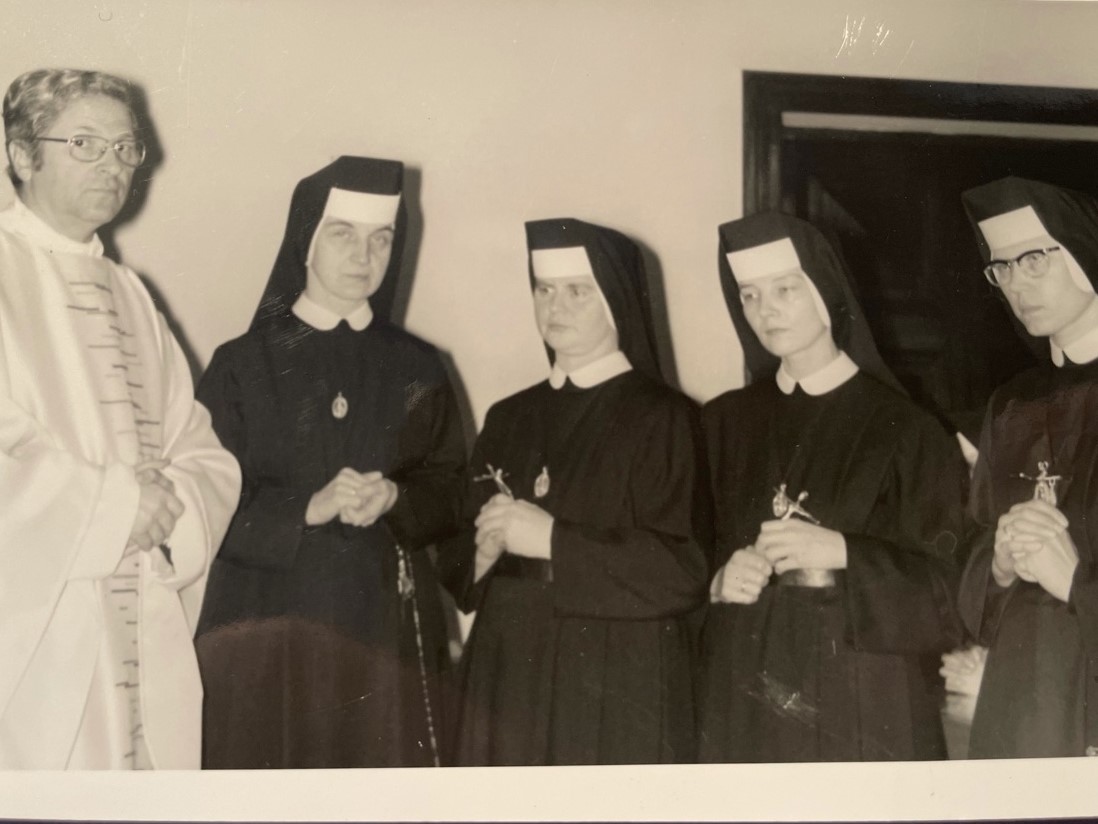
Lionja In 1974 Bishop Cotey asked for three sisters for another mission station in Lionja, which was also in the Diocese of Nachingwea. In December 1974, the General Management decided to take over this station. In 1976 three new Polish missionary sisters arrived in Tanzania and first went to Kilimarondo to acclimatize. However, when they arrived in Lionja at the beginning of March 1976, the planned buildings had not yet been prepared. Therefore, the arrangements had to be changed at short notice, and the sisters went to Nanjota. Nanjota Nanjota was 150 kilometers from Kilimarondo. On March 29, 1976, the second branch of the congregation in Tanzania was established here, initially with three sisters. The station of the Polish Salvatorians, where the sisters lived, consisted of a large house, a farm building with pens for pigs and small livestock, and a garden with numerous fruit trees. The population lived in simple mud huts covered with grass and tin. Their farms were outside the huts. Not all residents had beds and kitchen utensils. In contrast to Kilimarondo, the water here was scarce, it had to be collected and fetched from afar and was often polluted. On the site of the mission station there were tanks for collecting rainwater and a well. In Nanjota, as in Kilimarondo, the sisters worked in areas in which the congregation had been active in Europe for decades: they ran a kindergarten, taught sewing to the women, looked after the church and looked after a small hospital with 30 beds and treatment rooms for outpatients. In Nanjota, obstetrics was particularly important, so the sisters ran a maternity ward. At the end of the 1970s, there were only two sisters in Nanjota and in Kilimarondo, which made the continuation of the missionary work questionable. However, by mid-1984 their number had increased to four. On October 13, 1978, the Diocese of Nachingwea signed an agreement with the Congregation. It made the two stations in Kilimarondo and Nanjota available to the sisters for their missionary work, paid the sisters working there financial support and provided for their medical treatment while they were in Tanzania. The General Treasurer, Sister M. Notburga, organized support for the mission from Germany. She sent a wide variety of everyday items to Tanzania in containers. For several years, the women's community in Wenden donated the proceeds from a bazaar to the mission stations. novitiate The postulants who had initially been in Kilimarondo were cared for in Nanjota in 1990. The community of sisters partly provided for their own food by growing vegetables and raising poultry and pigs. The African novitiate was also opened in Nanjota. On December 7, 1990, the first four local novices were invested. Sister M. Konsolata Wilma was installed as mistress of novices. On December 8, 1992, three African novices made their first profession. The Superior General, Mother M. Angela, came to Africa specifically to receive them. Bishop Magnus Mwalunyungu personally preached the high mass because it was the first profession of Sisters of Mary in Africa. From 1990 to 1998, 22 novices were invested in Tanzania and 15 African sisters made profession. With the opening of the new branch in Chikukwe in 1998, the novitiate was moved there. House Superiors Evangelista Dąbrowska 05.03.1976 - Viannea Parchatko 06/01/1986 - Miriam Kusek 08.12.1994 - (Johannes Mertens, „Aus der Geschichte der Kongregation der Marienschwestern von der Unbefleckten Empfängnis“, Band 2, S. 628-630)