Letter from Tanzania

Letter from Tanzania

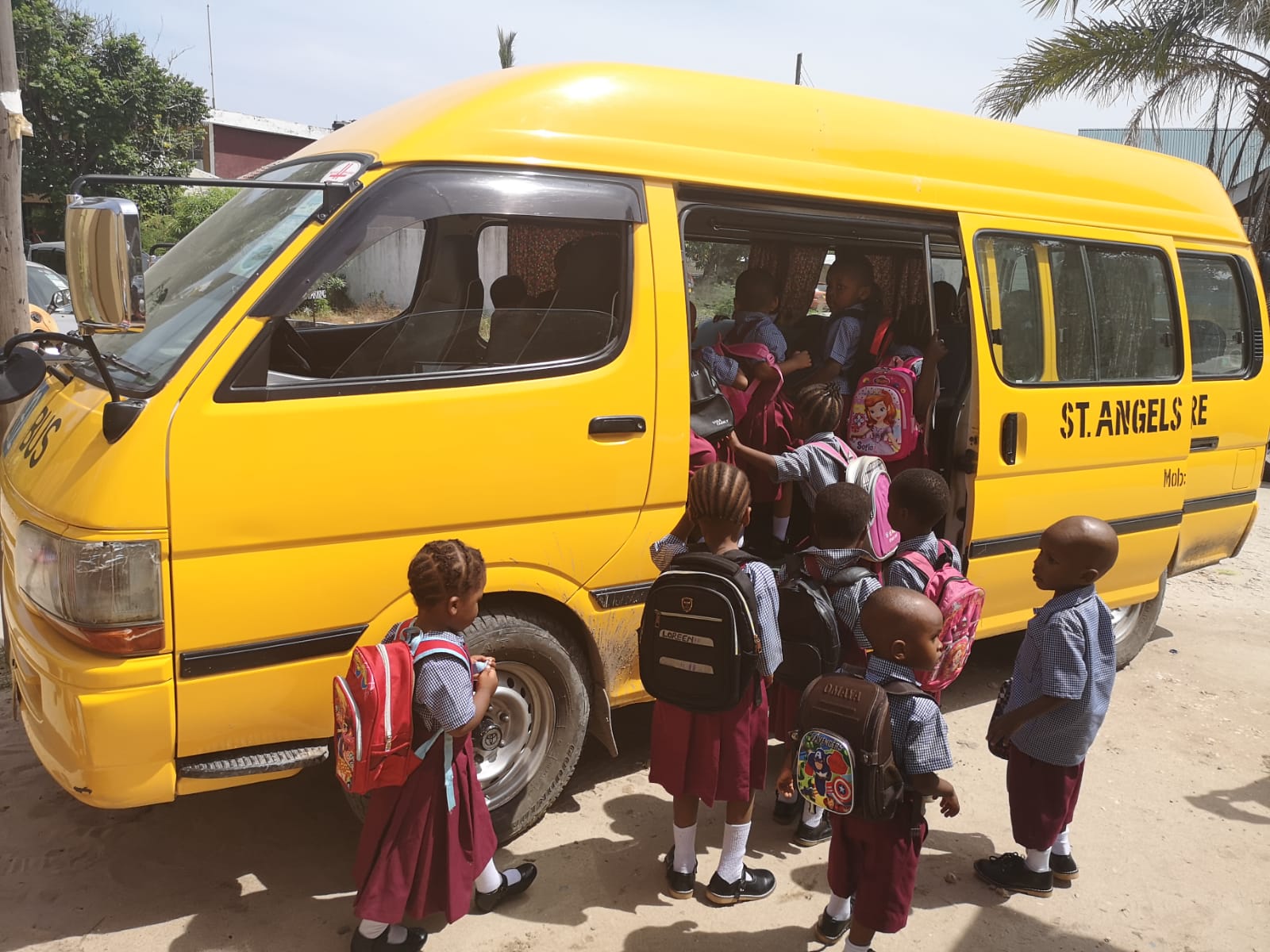
Dear Mission friends, Best warm regards from Tanzania. Six years have passed in my missionary work in Tanzania, where I was sent by my Congregation of the Sisters of Mary Immaculate. I currently live and work in Dar es Salaam. I am involved in the kindergarten, ST. ANGELS DAY CARE CENTER, I take care of the supply and the economic side of the facility by working with the Tanzanian, Sister Angela who is the director. Dar es Salaam is a port city that is still developing. Since I came to this country, I notice new roads, more and more cars. Rail transport for both passengers and luggage is developing. Not only our city, but the whole country is developing dynamically. Our Congregation has been present in Tanzania since 1973. Our concern is directed primarily to children, young people and women, but also to all those in need. We have been in Dar es Salaam since 2001. At first it was only catechesis in nearby schools and work in the parish. In 2006, the construction of a nursery was started in order to take care of children and thus enable young mothers to work. Before the construction was completed, it turned out that a kindergarten was more needed. And so it happened, a kindergarten was built, which is still functioning today. The first group of children was only seven, but the school year ended with 36. Every year the number of children increases. This year we have 120 preschoolers. They are children of different kinds of life and faith. Some children live at a considerable distance from the kindergarten, so they use the transport offered by our school. The school means of transport is an old bus that breaks down frequently. This makes the organization of school activities difficult and is also very expensive. The kindergarten is increasingly feeling the obstacles related to vehicle repair. We're trying to raise funds for a newer bus. The cost of the new car is $ 40,000. I applied to MIVA POLSKA for funding ($ 15,000) and to the Polish Embassy in Tanzania ($ 12,000). For our goal to be reached, we need another $ 13,000. We save on expenses, but it is still not enough, we count on the gift of the heart and the support of our friends. Together we can do more, give Tanzanian children an opportunity for education. With cordial greetings, remembrance in prayer Sr. M. Monika Kowarsz SM
Complaining

Complaining

Complaining is an attitude. It is not same as sharing the difficulties. Complaining is sharing with an attitude of inertia and discontent. Our complaints are about everything, weather, life, health, people and things that have not gone right. Before things that you don't like, focus on what you can change or do to make things right or better. Even if you are having a really bad day, put things into perspective. See the silver lining of the cloud. Live in a state of appreciation.  See the positive side of that happened using your intelligence and creativity. There is always something positive in everything because God is present always and everywhere. The No 'Complaining Rule' will work wonders for you and the people around you. It is a lot easier for people who have to listen to you. You will be surprised by how much better life is. Don Giorgio
“Under the ashes a secret fire”

“Under the ashes a secret fire”

This book by Joan Chittister, an American Benedictine nun, is a provocative book, which wants to shake up, awake and restless. The author deals with the problems of the Church, orders and spiritual communities of today because they are diverging and looking for new ones. It is not always easy to bear reading this book and I have sometimes found myself as described in the foreword: "The gesture of" angry-laying-out-of-hand, the-in-the-corner- throwing can be entirely appropriate to this reading. "But I didn't do it, I read it to the end and I'm grateful for it to this day because while reading this book, it is becoming increasingly clear: The author is not writing the book to criticize, complain or to blame. It is characterized by high esteem for religious life and looking for ways to rid it of incrustations and indurations and create new, lively ones to find life forms. The book literally breathes the author's love for religious life: “... it is about the godly burning passion that is required to form a present of religious life to find that between the cherished old and the emerging new, which paves new paths and develops in a world that is the turning point in history is shaken by constant change. " It is not easy to write a review of this book because every page is filled with this passion. Therefore we think it is good to also think about it in sections which we will send you gradually. So I would like to invite you in this first article, together with the author, to seek the meaning and mission of medals. For Sr. Joan, the most essential option for emergence is and the reason  for orders in the search for God. She writes: “In truth it has never given a good reason to enter religious life at all, except ‘for looking to God ‘.” In this context, she describes clearly and critically the situation of the orders and Congregations of our time and goes into historical contexts and developments and the influence of the Church and society. She clearly sees that what was meaningful and necessary in the beginning of the formation of communities is often only today is still preserving tradition and sticking to the familiar. Most of us entered the congregation when religious life was primarily shaped  of apostolic activity, self-sacrificing service, and common prayer as a strict daily structure. That was all well and good at the time, but here the development of society is probably outdated. Sr. Joan writes: “The spirituality of productivity is over.". And elsewhere: “If our main interest is in the work, the religious do, the religious life itself is consequently questioned as soon as their work - out of which whatever reason - becomes less important. ”Whereas in the past, medals went to the places where the State failed, i.e. to the sick, the elderly, the disabled, the poor, the dying, etc., the Society caught up a lot here. The pioneering work of the orders is done and now they are “as that needs what they should always be: a spiritual voice, a sign of a counterculture, a prophetic presence in culture. "At this point it is slowly becoming clear why the author uses the title “Under the ashes a secret fire” for her book. The image of fire and ashes reappearson. She herself is completely fulfilled, yes burns from this inner fire, but she experiences it. Religious communities often as groups that are internally extinguished and now only ashes preserve. And now it is up to us to keep the embers and rekindle the fire. But how? Sr. Joan warns, “If the fire is to be saved for another generation, it must keep the voice of God alive in religious life in this time.. ”And that is today, in one largely secularized and indifferent to religious life, often not light. On the one hand, it demands from us an intensive spiritual search, deepening in that Gospel, but at the same time, and that is the other side, a translation and transmission of the words and texts of Holy Scripture in the lives of people today. And it demands one dealing with the problems of people today, who are often so different than they were before 30 years ago. Our actions, our reactions and answers must be different. There are no ready-made, permanent solutions, everything is changing and in constant change.Also and especially religious life. Because if the external forms and circumstances also change, our inner mission always remains the same! And that is why religious are there at all times called to be prophets, i.e. the present with all its needs and problems in the light to see God and from this point of view to offer answers and solutions, often are not understood, ridiculed or even fought. But the world is waiting for it and she also expects from us: “The task of religious life ... is to translate the great questions of life in the language of all areas of life ... Is religious life itself religious enough to get you back to the gospel instead of going to the institutions focus, which certainly characterized it most in the past, but in this new era anchored elsewhere and are more part of the culture than acting prophetically towards it." (to be continued....) Sr.M. Petra Ladig
To be the right help at the right moment

To be the right help at the right moment

To be the right help at the right moment for someone is a blessing to our life. To be like that you cannot be waiting or looking around all the time. The best way is to become helpful all the time. Be sensitive to the well-being and happiness of others. Sense the sadness or the need for help. This sense you have to develop by accepting the uniqueness and importance of each person around us. Start with a kind word or a smile. Increase your sensitivity towards others and your world becomes beautiful. Don Giorgio
Celebrations in Tanzania

Celebrations in Tanzania

In Tanzania, after religious ceremonies (sisters' profession, novitiate and postulate), we begin another year of formation. Earlier, I wrote about planning these celebrations, now I will give some information about their course. After the spiritual preparation in which we were helped by the retreat, we started preparations in organizing the celebration. This year, due to the pandemic. The celebrations were somewhat cumulative in place and time. Everything took place in Chikukwe in two days. This "intense" celebration, however, had its own special charm. The immediate preparations were also, in a sense, another celebration - a holiday community and good cooperation. Sisters who came from other communities also helped work for celebrations. Each was given some responsibility: for example, Sr. Anna (the postulate mistress) and Sr. Yasinta (the superior of the Nunciature) were responsible for making mandazi and pilau (traditional food that cannot be missed in Tanzania during big occasions). Sr. Ksavera novice mistress was baking bread and bananas with meat. I was assigned to undress the meat preparation (Bull and chickens). Sr. Franciska, Superior of Nanjota decorated the chapel and was responsible for the liturgy together with Sr. Miriam. Of course there was a lot of fun during this work, but in moderation, because we wanted to respect the concentration of the sisters who prepared themselves spiritually for their great day. On the day of the celebration of August 28, for some, the wake up time was even at 2:00 A.M. for others at 4.00 AM to be in time with the cooking and final work by morning at 6.30. After common prayers, during the Holy mass four were accepted into the novitiate, postulants who took new names: Sr. Eliana, Sr. Prisca, Sr. Diana, Sr. Grace. In Tanzania, the external sign of novitiate admission is the habit and the white veil. For novices it is always a very important moment because it is visible to everyone change - not only in their lives, but even in appearance. Habits and veils were blessed by Bishop and blessed our new sisters who now, through daily work, prayer, the study of the Word of God and our Constitutions, but above all through ones common living in joys and problems will prepare themselves to confirm their intention to dedicate one's life to God in a religious community. After the photo session in beautiful, new habits and a quick but common one for breakfast, there was the last singing attempt under the watchful eye of Sr. Anna.   At 10.00 a solemn mass began with three novices: Sr.M. Stefania, Sr.M. Emilia, Sr.M. MarcelIna,made their first religious vows. And Sr. M. Regina, Sr. M. Clelia, Sr. M. Innocencia, Sr M. Theodora, made their perpetual vows. The liturgy of the Holy Mass itself lasted two and  half hours. Probably this time will fall deep in the hearts of these sisters, the time of the wedding with Christ and total surrender to Him. This moment is never forgotten! Remembering this moment, I think accompanies each of us, no matter what religious internship and helps us through difficult times in our ministry and in spiritual development. These solemn and beautiful celebrations aroused a lot in us joy in the present moment, with new sisters, but also with many memories of our own celebration. After the beautiful liturgy and the satisfaction of the first hunger, there was an artistic part, during which novices and juniors performed various songs, dances and skits. Looking at them, how joyfully they entertained us, I wondered when they had have prepared? After all, there was so much other work before the celebrations. Singing and dancing are an inseparable element of all celebrations in Africa. When celebrating, it's hard to do without singing and dancing. Anyway, one thing entails second. How to sing without moving to the beat of the music? How to move rhythmically without drums? I think that the dance is a mirror of our sisters' interior. Both this one during liturgy and recreation. The next day, five candidates in Nanjota were admitted to the postulate. For myself, this time of celebration is always a great joy because I can see how the Congregation lives and grows here. I am grateful to God that I can participate in celebrations that are slowly being forgotten in Poland as a result of lack of vocations. Then I remember my veills, my first and perpetual vows. It is also a moment of reflection on my zeal and faithfulness to God. Let us be grateful to God for every vocation in Tanzania.   S.M. Monika