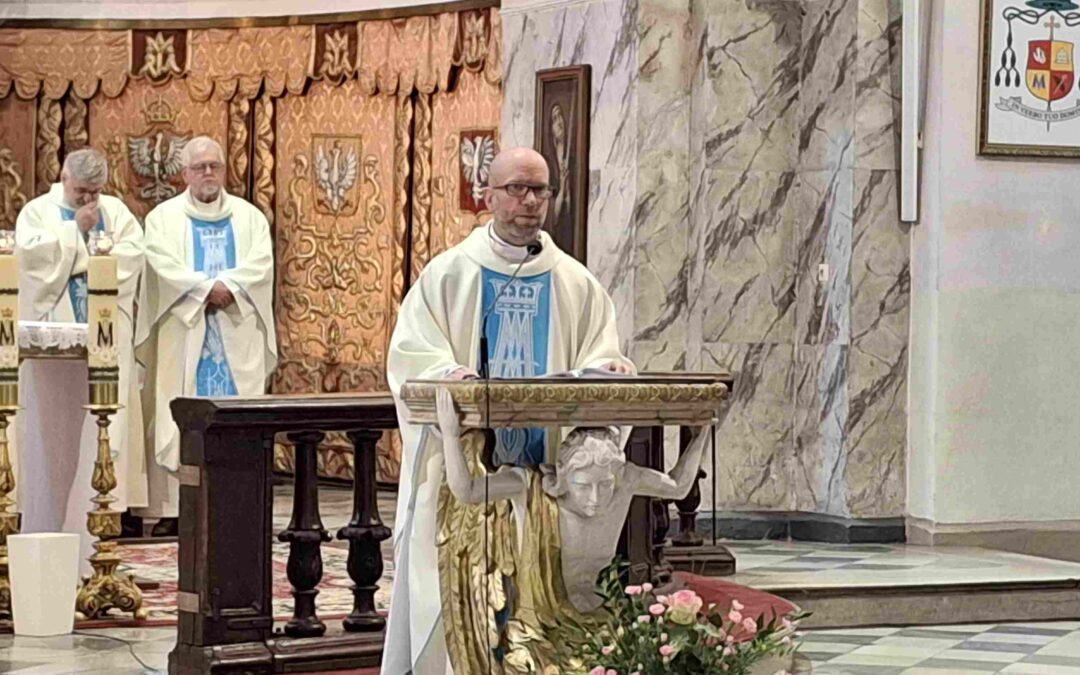
Homilia z okazji pielgrzymki dziękczynnej do Barda
One mountaineering account describes a situation in which a man was stranded high up in the mountains on a narrow rock ledge during a storm. The wind was so strong that it was impossible to go up or down. Raindrops bounced off the rocks like needles, his hands were numb with cold, and every movement threatened to make him fall. At one point, in the darkness and rain, he felt a small depression in the rock with his hand — almost invisible, inconspicuous. He slipped his fingers into it and leaned his entire weight on it. This small, invisible support allowed him to survive the whole night. The mountain did not change, the storm did not stop, but there was a point that prevented him from falling into the abyss. This image aptly describes the situation of many people and many communities in difficult moments of history. There are times when the wind of events, decisions, persecution, and fears blows with full force. And yet there is a “recess in the rock” that the world often does not see — the quiet presence of God, His grace, and the intercession of Mary. For you, Sisters of Mary Immaculate, in moments of danger and struggle for the survival of the Congregation, Mary, the Guardian of Faith, was that support. She did not take away the difficult experiences, but she prevented faith from falling into the abyss. In today's Gospel, Jesus enters the temple and makes a radical gesture: He drives out the merchants, disrupts their arrangements, and purifies the place of prayer. This is one of Jesus' most violent actions — and one of the most loving. The Greek word that Luke uses to say that Jesus “drove out” (ἐξέβαλεν) is the same word that describes the casting out of demons. Jesus is not angry with people—He is fighting against what destroys the heart of prayer. He is not fighting against man, but for man. And Luke goes on to emphasize that “every day He taught in the temple.” It is a beautiful juxtaposition: on the one hand, the strength and courage of purification, on the other, a gentle, patient presence. Jesus removes what gets in the way, but He stays to give life. Purification is not the end, but the beginning. Moreover, Luke notes that “the people listened to Him with bated breath” (ἐξεκρέματο αὐτοῦ ἀκούων – literally “hung on His lips”). This is an extraordinary image: people clinging to Jesus' words like a climber clinging to a rock ledge. The word of God is a support in times of storm. Sisters of Mary Immaculate, your Congregation has experienced its own “cleansing of the temple” in history: times of trials, threats, and even moments of near destruction. But it was precisely then that the truth, which your Constitutions remind us of, was revealed even more strongly: “Our apostolate will only be fruitful if we are deeply united with Christ. He is the source of our spiritual life and the strength of our dedication to our neighbors” (Constitutions, 92). This sentence is like a key that unlocks today's Gospel. Jesus, in cleansing the temple, does not destroy it—He restores its heart. Similarly, in the history of your Congregation, in times of trial, Jesus, through Mary, did not allow that heart to be extinguished: prayer, adoration, daily perseverance with Him. Your fidelity was not merely survival, but—as the Final Document of the 21st Chapter says—being rooted in the primacy of grace: “The renewal of our vocation in today's world is possible only through the recognition of the primacy of grace and the rediscovery of spiritual depth.” This is an extremely powerful message for today. In a world that says, “What counts is effectiveness, projects, numbers, plans,” the Chapter reminds us that everything begins with grace. Not with strategy, but with remaining with Jesus—just like the people in the temple who “hung on His every word.” And one more sentence from the Chapter that particularly resonates with your pilgrimage to Mary, Guardian of the Faith: Your identity as Sisters of Mary Immaculate is not just a name, but a mission: “We feel called to revive our Marian spirituality (...) by listening to and meditating on the Word of God and presenting Mary as a model.” Mary of Bardo – Guardian of the Faith – teaches precisely this kind of listening and perseverance. She did not stop the storm, she did not take away the cross, but she ensured that faith did not die out. And in the same way, she did not allow your Congregation to die out. That is why today your thanksgiving is not just a memory of the past. It is a renewal of the decision: to be a temple purified by Christ, nurturing the primacy of grace, in which Mary guards the faith — not as an exhibit, but as a living fire. In a moment, we will participate in the Eucharist — in the mystery in which Jesus enters the temple again. Into the temple of our hearts and into the temple of your Congregation. Every Holy Mass is a moment of purification: He removes what hinders us and stays with us — every day, just as He taught every day in the temple. When the priest raises the Host, Mary, the Guardian of Faith, teaches us her gaze beneath the Cross: a gaze that never turns away from the mystery of God acting amid difficulties. She teaches us that fidelity is not a feeling, but perseverance. That salvation comes from trust. That the Word is truly a rock. Today we give thanks for the salvation of your Congregation. But at the same time, we entrust it anew to Mary – that she may always be your Guardian of the Faith. May each sister listen to Jesus “with bated breath.” May Jesus purify what needs to be purified and teach you daily in the temple of your hearts.
Ks. Bartosz Trojanowski