


Memories of sister Lucia (Eugenia Jakubowicz)
On Sunday morning, August 2, 2020, our sister Lucia (Eugenia Jakubowicz), who from 1976 was associated with the Care and Treatment Center for children in Piszkowice, and from 1985 she was constantly managing the Center, passed away. Over the years, she not only built a high-class center for sick children, but above all created an unusual atmosphere of love, kindness and trust in God in every matter. For this special attitude to her pupils, in 2017 she was awarded the Order of the Smile, the highest international award granted by children. Sr. Lucia was very modest and never liked to talk about herself - both about her successes and about the suffering that she also experienced very much while fighting cancer. Now let those who knew her every day and are witnesses of her life speak. MEMORIES It is impossible to close someone's life in a dozen or so sentences. It is impossible to put into words work, meeting, devotion and sacrifice in everyday life. Anyway, these descriptions are usually very similar to each other and, somehow, can be attributed to each of our departed loved ones. To understand what life was like for sister Lucia, you must first visit Piszkowice and spend some time there, meet the pupils, see the specifics of the place and people. A place where something happens 24 hours a day. Because it's not a workplace. Over the years, the sisters have built a real home there, and at home, they do not look after family members at specific times. One is at home, lives and lives. It is built together, being ready to help at any time. Once you get to know the children, you need to talk to those who are involved in the daily life of the center. From sisters, to medical staff, to people cooking in the kitchen or smoking in the boiler room - the family that was established in Piszkowice was created by each of these people. Everything you see has to be overlaid with stories that will not always be told by those you meet there. The legal system meant that the house in Piszkowice was struggling with financial problems all the time. While the sickness fund paid for medical care, it did not contribute to the ongoing support of the children. Those, often left behind by parents, were in a sense invisible to the social welfare system - so there was not enough money for clothes or equipment for learning or playing. You may not hear about it in Piszkowice. Because problems were not discussed, problems were solved. Each day was filled with work from morning to evening. And next to her, as it is at home, the birthday of each of the household members was celebrated, small successes were celebrated, the end of the school year, children's day, St. Nicholas' Day were celebrated ... in Piszkowice she rushed so quickly that we believed that the place and the people who take care of the house are eternal. Now you will probably ask why there is so much houses in Piszkowice in this memory, and so few sisters Łucia? It was all Lucia. It was she who created the house from 1976 until the very end. It was she who created a family from people working from home. It was she who looked after the children, ensuring that they had everything they need. She never complained ... It was sister Lucia who created Piszkowice as we know it. Of course, she didn't do it herself, but everything that happened there was because of her. We don't know a softer person. Full of humility and peace. Full time for others. Because Sister Lucia always had time. Yes, its time, cut off from rest or a moment for yourself. She was always ready to give it to other people. When more diseases fell on her, nothing changed in Piszkowice. As subsequent diagnoses spoke about the deteriorating condition, and the doctors even ordered rest, Sister Lucia repeated her daily ritual, in which prayer interwined with time for the patients, employees of the center, and guests. She had called a lot more in the last week. Even for a moment, just to throw one sentence - "Please pray" - and dropping it, she went back to work. The last time I spoke to her was Saturday, August 1 at 4.45pm. She knew how serious the situation was in the Center, she left me asking, "What will happen now?" In a calm, strong voice. She gave all her life to God. I don't think she's scared. Rather, she was curious how God would solve this - her - case. She asked for a prayer, we assured her. We made an appointment on the phone on Sunday. I never heard her again. I have known Sister Lucia all my life. She believed in God, she believed in people. She always gave chances and always held out her hand. She talked about how every man can fall, but no one should keep falling - and that you must always be able to help him, try to help. From the small Piszkowice she saw the world far wider than the great travelers saw it. There, by deed, she showed what she believed and what she understood. I have known her always the same, until the very end. Words won't tell you much about Sister Lucia. Her Piszkowice will tell you about her. Radek Michalski *** Sister Lucia was a very modest woman with a big heart, in which there was a place for everyone. You could quietly immerse yourself in prayer with her, and in a moment organize a great undertaking for the good of the children who were all of her world. Sister Lucia always put each person and their problems first. She could listen to the softest whisper. She helped everyone without exception, and for the smallest, most disadvantaged and abandoned, she was like a mother. The words of Sister Lucia ring in my ears all the time: "... remember, you have to be good to people like bread, because good always returns, not here on earth, then there, in heaven." And she was just like that, good as bread. Now she looks down on us and I know that she will be asking God for favors for us, guarding and protecting her beloved Piszkowice, as she did all her life. Edyta Tomczak - accountant from Piszkowice *** Sister Lucia was a good woman. She shared the love she drew from Jesus and Mary. She had a special devotion to St. Joseph and Mother Teresa of Calcutta. She was open to the needs of the children she loved as a mother and she cared for them. She was enterprising - she expanded the compound to improve the living conditions of children, she dug a well so that there was no shortage of water. This sister was open to the needs of others, everyone in different situations received help, which she provided with kindness and a smile. Despite experiencing a serious illness, the sister fulfilled her duties to the end in an attitude of humility and trust in God.- Agata Jank

God is present in every situation of our life
God is present in every situation of our life. So, to make the present situation better, find the goodness and richness of the present situation whatever it is. Especially when it is a difficult situation. But important is not to resist when you have nothing to do except accepting. When we resist, we create a lot of friction and cause ourselves even more pain. Take a river flowing from its source to the ocean. It knows where it is going and is determined to get there. It meets many obstacles along the way, does it resist them? Does it stop to discuss with the mountain that is in its way and why it is there and demand that it moves out of its way? No, it accepts that the mountain is there and just goes around it. In doing so it actually gets to its destination much more quickly than it would if it stopped to argue with the mountain. Stop arguing with the mountain and concentrate to your destination. Don Giorgio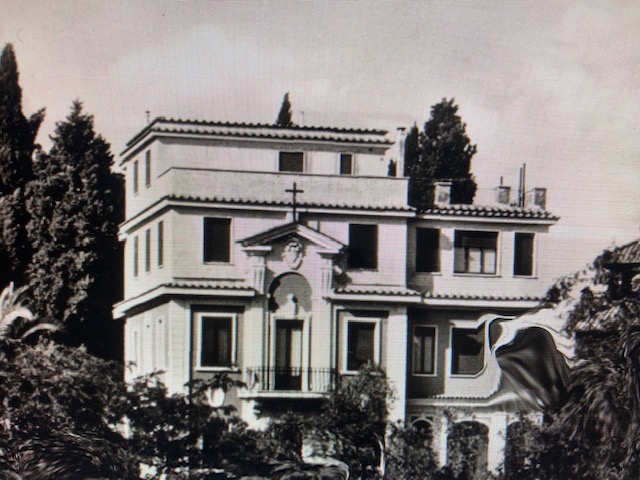
History of the Generalate in Rome Part I
General Chapter in 1963 and 1969
After the end of World War II, the political situation in the areas where the Congregation had previously developed changed greatly. The change of the Polish-German border and the resettlement of the population has largely transformed the structure of the Congregation, which was forcibly divided between the two countries. Many sisters were also resettled from Silesia to Germany. At the same time, it became necessary to move the Generalate from Wrocław to Berlin, and the tightly closed Polish-German border for many years separated both parts of the Congregation. Despite this, the sisters used every opportunity to create an opportunity for unification and to begin building relations between the representatives of the two nations.
The first two general chapters after the war were important for the breakthrough in these national relations of the Sisters of Mary Immaculate. This was not only an opportunity for representatives of all provinces of the Congregation to meet, but above all important decisions were taken at that time, resulting in significant structural and mental changes of the Congregation.
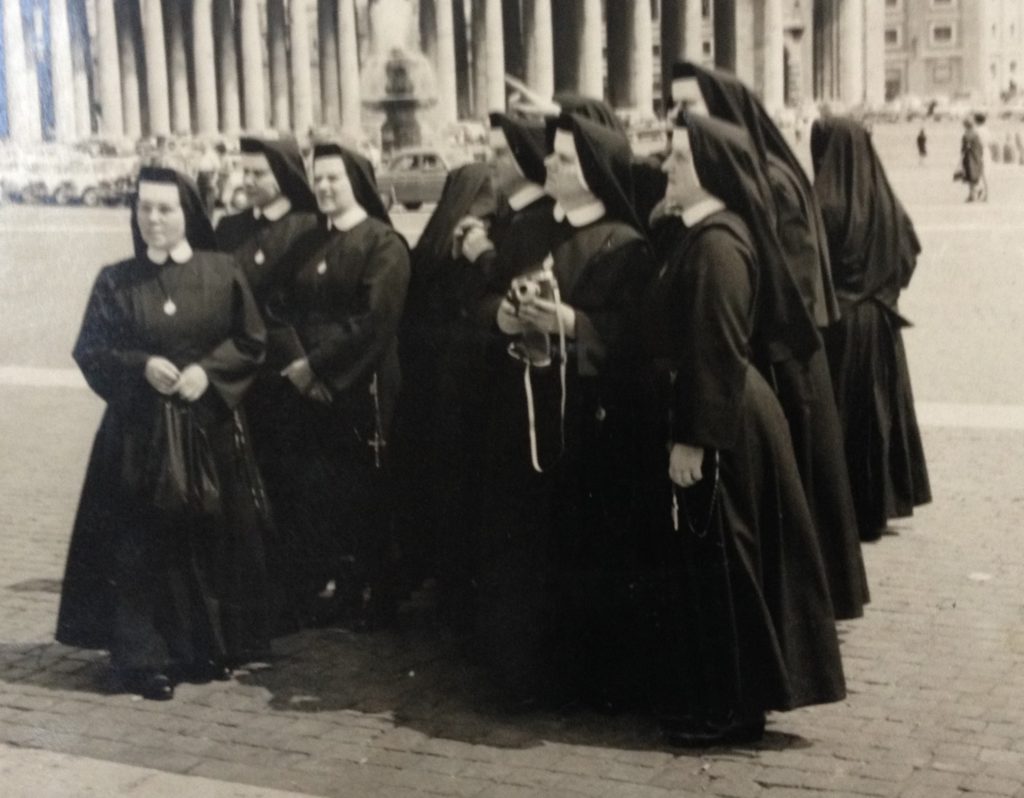
The last general chapter of the Congregation took place in Wrocław in 1944 before the end of the war. In 1950 and 1956, due to difficulties in crossing the Polish-German border, the chapter did not take place, and the term of office of the superior general was extended by the Holy See. Also in 1962, it was not possible to return to Germany for the chapter of the Polish delegates, for this reason it was decided to move the deliberations from the traditional place, which was the seat of the superior general to Rome. Sisters from Poland at that time were more likely to receive permission to go to Italy than to Germany. In March 1963, the date and place of the General Chapter of the Congregation, which was to be held in Rome from 1 July of that year, was announced. The time from the announcement to the beginning of the chapter turned out to be too short for the Polish provinces of the Congregation. It was necessary, because during the provincial chapters, delegates from all provinces were elected to the General Chapter, and then to initiate attempts to obtain passports and exit permits for these people from Poland. For this reason, the beginning of the General Chapter was postponed to 1 September 1963. At the request of the inspector general, Sister Cecylia Mateja, the efforts of the sisters were personally supported by cardinal Stefan Wyszyński. In the end, all the delegates received a leave permit, which was scheduled for September 1. For the sisters who left the country for the first time, it was a big event. All the delegates first came to the provincial house in Katowice. The curator of the Polish part of the Congregation, Fr. Alexander Oberc, who gave his farewell address and gave his final guidance before the General Chapter. He stressed in particular the need to try to move the general house from Berlin to Rome. After a solemn farewell, the sisters set off by train to Rome.
The delegates of the German provinces of the Congregation arrived in Rome on August 30, 1963. On 2 September, despite the absence of sisters from Poland, the chapter began with a day of recollection. The next day, the relevant deliberations of the Chapter began, but without the presence of all participants, no vote could be held. The delegates present in Rome began to fear that the polish sisters would not reach the chapter. In this situation, the possible choice of the superior general without the presence of part of the chapter was considered, but because of the constitutional provision this would not actually be possible. The following day of deliberations, on September 3, the sisters present for the chapter went to Castel Gandolfo for wednesday's audience of Pope Paul VI. On the way back they met a group of sisters from Poland, who arrived in Rome at that time. The next day, the first general chapter of the Congregation began in full composition after the end of World War II. The 20-year break in the general chapter and the political and social situation in which the Congregation was developing at that time required significant changes in the religious provisions of the Congregation.
The new general superior was chosen, which was S. Gertrud Hannig. Among the most important provisions of the Chapter are the beginning of work on amendments to the Constitution of the congregation. Some provisions on religious clothing have also been amended. The plight of the Berlin outposts, which lost contact with the provincial house in East Berlin, was resolved by politically divided the city in 1961. A separate province has been established for religious houses located in West Berlin. The Wish of the Chapter was, whenever possible, to begin missionary work. In this regard, a provision in the Constitutions referring to the missionary tasks of the Congregation has also been added. Delegates from Poland made a request to move the general house from Germany to Rome. The reason was the difficulties made by the Polish State in obtaining permission to go to Germany. However, this was not the only reason why such a request was made. Delegates from Poland and Germany equally wanted to restore unity in the Congregation, which involved the assumption of real power by the Superior General also in the Polish part of the Congregation, where since 1947 she has been a general visitor. The polish delegations also influenced the experience of the sisters in Silesia, who were harassed by the communist authorities on the pretext of belonging to the German assembly, whose headquarters were located in West Berlin. These reasons were understood by the new Superior General Gertrud and her council, although it was risky to move her headquarters from Berlin to a foreign country, requiring not only personal sacrifice from mostly German, the sisters of generality, but also the purchase of a suitable building and financial security for the maintenance of the sisters in Italy. Generalate undertook to launch the house in Rome as soon as possible.
The new General Council also sought to begin implementing the remaining provisions of the Chapter. The Constitutions of the Congregation were translated from Latin to German, amended and included in the provision of missionary tasks. This was especially important for the sisters from the Polish part of the Congregation, who had already been offered missionary work in Africa and Brazil. It was realized that starting a business in culturally alien areas would require the sisters to have good education and preparation, and their eventual departure would not be earlier than after the next chapter, which was to take place in 1969, but the development of appropriate provisions in the Constitution of the Congregation made it possible in the future to allow the sisters to go to missionary work.
The General Chapter of 1963 was not only important for rebuilding the unity of the Congregation, but created opportunities for the territorial development of the Congregation to the missionary countries. Such a decision influenced the mentality of many sisters both in Poland and in Germany, who began to see their congregation as a supranational and universal community. The provisions of the first Chapter of the General Assembly after the war proved therefore crucial for the further development of the Congregation. These deliberations coincided with the Vatican II Council, the second vatican council, whose resolutions brought about major changes throughout the Catholic Church and, consequently, also in the Congregation of the Sisters of Mary Immaculate.
In June 1965, Sr. Gertrud held a meeting of the entire General Council in Rome. At that time, it was not yet possible for the superior general of Polish institutions to visit. The council meeting from Poland was attended by the inspector general, Cecylia Mateja, and Sr. Lidia Piwowarska. The meeting place was the house of the Carmelite sisters at Via Trionfale.
Finding a house in Rome where the sisters could open an outpost was not an easy task. Through the Congregation of the Holy See, Sr. Gertrud learned that the Benedictines of S. Girolamo Abbey in Rome were looking for sisters to lead the kitchen there. The sisters accepted this offer and after the signing of the agreement in July 1965, the institution was to be taken over by three sisters from Poland and one from Germany. The superior of the house was S. Lidia, who did not return to Poland for fear of difficulties with the return of the house, stayed in Rome after a meeting of the General Council. From Berlin she came to the abbey of S. Mathilde, but the other two sisters from Poland who were to start work in Rome did not receive permission to leave the country. Until 1969, two sisters in a Roman institution were assisted only by their German sisters.
In September 1969, the next General Chapter of the Congregation was to begin. The Polish sisters began their efforts to travel to Rome as early as December 1968. Also, the sisters from the GDR, who for the first time since the establishment of the Berlin Wall, were granted permission to go abroad. The chapter was presided over by the curator of the Brandenburg Provincial Assembly Archbishop Heinrich Theising. The Chapter re-elected M. Gertrud as general superior.
Much space was devoted during the deliberations to the detailed discussion of the Constitution of the Congregation, which had been drawn up since the previous Chapter, and the General Chapter in 1969 was to approve it.
During this Chapter, the issue of communication difficulties was raised not only between Poland and Germany, but also between two German provinces, which have been officially functioning separately since 1967. However, this would mean the split of the Congregation and the loss of unity sought with great dedication by the sisters of both nationalities in the difficultpost-war years. In the end, the division into regions was adopted. The Polish region was formed by the provinces of Wroclaw, Branice and Katowice, while the German region was composed of the Provinces of Brandenburg, West Berlin and West German. The regions were managed by regional superiors, which were under the responsibility of the superior general. In this way, attempts were made to solve the communication and structural problems that the Congregation faced as a result of political divisions, while at the same time maintaining unity while leaving the one-man office of the Superior General.
Relocation of the generalate's headquarters from Berlin to Rome in 1970
The superior general, obliged by the order of the chapter, went to Rome twice in the last months of 1969 to search for a suitable building for the headquarters of the generalate. However, this search did not produce the expected result. Such actions were also taken from Germany. After an intensive search since August 1, 1970, the Congregation rented rooms in the Franciscan sisters' monastery in Rome at La Storta for the headquarters of the generalate. The residence of the superior general and her council in a rented building in Italy required many sacrifices and openness to the changes made by the General Board. They left a well-organised, assembly-owned building in Berlin, including rented premises in a foreign state and without permanent financial security. However, it was decided to take such risks because of the opportunity to improve contact with the Polish part of the Congregation, as well as the possibility of the aforementioned missionary expansion.
The maintenance of the general house in Rome was undertaken by both the German provinces, financing in part its functioning, and polish. However, due to a lack of financial resources, they were left to work in Italy and thus ensure the maintenance of the generalate. Initially, they were to take up the position of nurses at a hospital in Tivoli near Rome, but shortly before they arrived in Italy on 10 January 1970, the hospital management reserved the need for Polish sisters to speak Italian, which at this stage prevented them from being employed in the hospital. In this situation, the superior general of the Main Providence sisters, in Rome,the Marian sisters held the GeneralChapter, suggested that polish sisters preparing to work in an Italian hospital would be able to live in their facility at Via S. Giovanni Eudes, where they could learn the language in exchange for help in their homework. After a few months in the institution of the Congregation of Divine Providence in Rome, four of our sisters found work at the Sanatrix clinic in Naples. Part of the financial resources thus obtained were used for the maintenance of the generalate.
However, the search for a building near the centre of Rome, which was intended to be purchased for the permanent headquarters of the generalate, was not abandoned. On November 17, 1971, the superior general made a pilgrimage to Father Pio's tomb to complete the case. The next day, the Missionary sisters from the Sacred Heart of Jesus applied to the generalate of our Congregation with an offer to sell a house in Rome at Via Trionfale. The building was small, but it was in a convenient place, for this reason it was decided to buy. After a minor renovation, from 1 June 1972 it became the seat of the General Board of the Congregation.
The fact that the general board of directors was transferred from Berlin to Rome contributed, as has already been mentioned, to easier contact between the superior general and all the institutions of the Congregation, although this possibility has increasingly also emerged between Poland and Germany. However, a deeper consequence of the transfer of the generalate to Rome was a gradual change in mentality among the members of the Congregation, who increasingly viewed the Congregation as international rather than just Polish-German. These processes were significantly contributed both to the expansion of the Congregation to Italy discussed above and to the establishment of missionary houses in Africa in the following years.
The continuation will follow.
